


Page 483 - 9780077418427.pdf
P. 483
/Users/user-f465/Desktop
          tiL12214_ch18_455-476.indd Page 460  9/3/10  6:21 PM user-f465
          tiL12214_ch18_455-476.indd Page 460  9/3/10  6:21 PM user-f465                                                /Users/user-f465/Desktop


                                                                                   Oceanic crust                Continental crust


                                                                                                Crust
                                                                                              Uppermost mantle     Lithosphere
                                                                                        Mantle  Asthenosphere

                                                                                                (part of mantle)

                                                                                           Mantle continues downward


                                                              6,370 km
                                                  Inner
                                                  core


                                                  Outer core        2,900 km


                                                               Mantle


                                                                             Crust


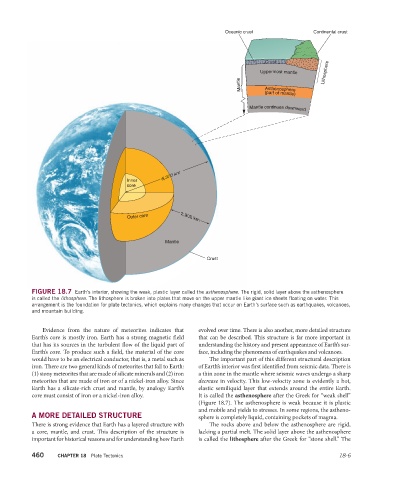
                   FIGURE 18.7  Earth’s interior, showing the weak, plastic layer called the asthenosphere. The rigid, solid layer above the asthenosphere
                   is called the lithosphere. The lithosphere is broken into plates that move on the upper mantle like giant ice sheets floating on water. This
                   arrangement is the foundation for plate tectonics, which explains many changes that occur on Earth’s surface such as earthquakes, volcanoes,
                   and mountain building.


                      Evidence from the nature of meteorites indicates that   evolved over time. There is also another, more detailed structure
                   Earth’s core is mostly iron. Earth has a strong magnetic field   that can be described. This structure is far more  important in
                   that has its sources in the turbulent flow of the liquid part of   understanding the history and present appearance of Earth’s sur-
                   Earth’s core. To produce such a field, the material of the core   face, including the phenomena of earthquakes and volcanoes.
                   would have to be an electrical conductor, that is, a metal such as   The important part of this different structural description
                   iron. There are two general kinds of meteorites that fall to Earth:   of Earth’s interior was first identified from seismic data. There is
                   (1) stony meteorites that are made of silicate minerals and (2) iron   a thin zone in the mantle where seismic waves undergo a sharp
                   meteorites that are made of iron or of a nickel-iron alloy. Since   decrease in velocity. This low-velocity zone is evidently a hot,
                   Earth has a silicate-rich crust and mantle, by analogy Earth’s   elastic semiliquid layer that extends around the entire Earth.
                   core must consist of iron or a nickel-iron alloy.      It is called the asthenosphere after the Greek for “weak shell”
                                                                          (Figure 18.7). The asthenosphere is weak because it is plastic
                                                                          and mobile and yields to stresses. In some regions, the astheno-
                   A MORE DETAILED STRUCTURE                              sphere is completely liquid, containing pockets of magma.
                   There is strong evidence that Earth has a layered structure with   The rocks above and below the asthenosphere are rigid,
                   a core, mantle, and crust. This description of the structure is   lacking a partial melt. The solid layer above the asthenosphere
                   important for historical reasons and for understanding how Earth   is called the lithosphere after the Greek for “stone shell.” The

                   460     CHAPTER 18 Plate Tectonics                                                                   18-6

