


Page 51 - 9780077418427.pdf
P. 51
/Users/user-f465/Desktop
tiL12214_ch02_025-060.indd Page 28 9/1/10 9:55 PM user-f465
tiL12214_ch02_025-060.indd Page 28 9/1/10 9:55 PM user-f465 /Users/user-f465/Desktop
It is easier to study the relationships between quantities if you and the t’s on the right cancel, leaving
use symbols instead of writing out the whole word. The letter v
vt = d or d = vt
can be used to stand for speed, the letter d can be used to stand for
distance, and the letter t to stand for time. A bar over the v (v) is If the v is 50 km/h and the time traveled is 2 h, then
a symbol that means average (it is read “v-bar” or “v-average”). The _
)
(
km
relationship between average speed, distance, and time is therefore d = 50 (2h)
h
d _ _
( )
km
v = = (50)(2) (h)
t
h
(km)(h)
equation 2.1 _
= 100
h
This is one of the three types of equations that were discussed
on page 10 , and in this case, the equation defines a motion = 100 km
property. You can use this relationship to find average speed. Notice how both the numerical values and the units were treated
For example, suppose a car travels 150 km in 3 h. What was the mathematically. See “How to Solve Problems” in chapter 1 for
average speed? Since d = 150 km and t = 3 h, then more information.
_
150 km
v =
3 h
_
km
= 50
h
EXAMPLE 2.1
As with other equations, you can mathematically solve The driver of a car moving at 72.0 km/h drops a road map on the floor.
the equation for any term as long as two variables are known It takes him 3.00 seconds to locate and pick up the map. How far did he
(Figure 2.3). For example, suppose you know the speed and the travel during this time?
time but want to find the distance traveled. You can solve this by
first writing the relationship
SOLUTION
d _
v = The car has a speed of 72.0 km/h and the time factor is 3.00 s, so km/h
t must be converted to m/s. From inside the front cover of this book, the
and then multiplying both sides of the equation by t (to get d on conversion factor is 1 km/h = 0.2778 m/s, so
one side by itself), m _
0.2778
_ _
s
km
(d)(t)
_ v = _ × 72.0
km
h
(v)(t) =
t h
m _ _ _
km
h
= (0.2778)(72.0) × ×
s km h
m _
= 20.0
s
The relationship between the three variables, v, t, and d, is found in
equation 2.1: v = d/t.
200 m _ d _
v = 20.0 v =
s t
t = 3.00 s dt _
d
150 – v 50 km/h d = ? vt =
150 km
t
Distance (km) 100 ∆y 100 km d = vt m _
t
3 h
= ( 20.0 ) (3.00 s)
s
∆x
2 h
m _ _
s
50 slope = (20.0)(3.00) ×
50 km/h
s 1
= 60.0 m
0
0 1 2 3
Time (h)
EXAMPLE 2.2
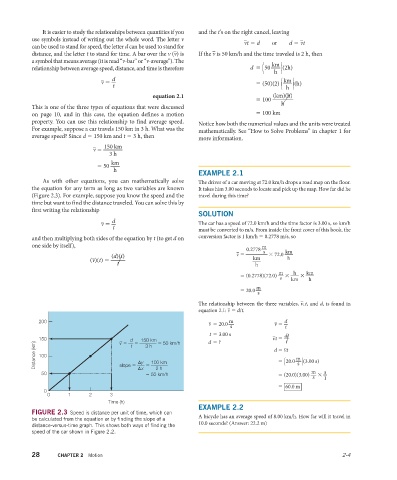
FIGURE 2.3 Speed is distance per unit of time, which can
be calculated from the equation or by finding the slope of a A bicycle has an average speed of 8.00 km/h. How far will it travel in
10.0 seconds? (Answer: 22.2 m)
distance-versus-time graph. This shows both ways of finding the
speed of the car shown in Figure 2.2.
28 CHAPTER 2 Motion 2-4

