


Page 52 - 9780077418427.pdf
P. 52
/Users/user-f465/Desktop
          tiL12214_ch02_025-060.indd Page 29  9/1/10  9:55 PM user-f465
          tiL12214_ch02_025-060.indd Page 29  9/1/10  9:55 PM user-f465                                                 /Users/user-f465/Desktop


                              CONCEPTS Applied

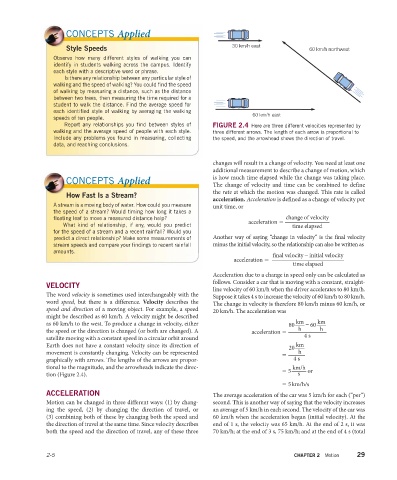
                              Style Speeds                                           30 km/h east              60 km/h northwest
                          Observe how many different styles of walking you can
                          identify in students walking across the campus. Identify
                          each style with a descriptive word or phrase.
                             Is there any relationship between any particular style of
                          walking and the speed of walking? You could find the speed
                          of walking by measuring a distance, such as the distance
                          between two trees, then measuring the time required for a
                          student to walk the distance. Find the average speed for
                          each identified style of walking by averaging the walking         60 km/h east
                          speeds of ten people.
                             Report any relationships you find between styles of   FIGURE 2.4  Here are three different velocities represented by
                          walking and the average speed of people with each style.   three different arrows. The length of each arrow is proportional to
                          Include any problems you found in measuring, collecting   the speed, and the arrowhead shows the direction of travel.
                          data, and reaching conclusions.


                                                                               changes will result in a change of velocity. You need at least one
                                                                               additional measurement to describe a change of motion, which
                              CONCEPTS Applied                                 is how much time elapsed while the change was taking place.
                                                                               The change of velocity and time can be combined to define
                                                                               the rate at which the motion was changed. This rate is called
                              How Fast Is a Stream?
                                                                                 acceleration. Acceleration is defined as a change of velocity per
                          A stream is a moving body of water. How could you measure   unit time, or
                          the speed of a stream? Would timing how long it takes a
                                                                                                       change of velocity
                          floating leaf to move a measured distance help?                              __

                             What kind of relationship, if any, would you predict         acceleration =      time elapsed
                          for the speed of a stream and a recent rainfall? Would you
                          predict a  direct relationship? Make some measurements of   Another way of saying “change in velocity” is the final velocity
                          stream speeds and compare your findings to recent rainfall     minus the initial velocity, so the relationship can also be written as
                          amounts.
                                                                                                  final velocity – initial velocity
                                                                                                  ___

                                                                                      acceleration =
                                                                                                         time elapsed
                                                                               Acceleration due to a change in speed only can be calculated as
                                                                               follows. Consider a car that is moving with a constant, straight-
                       VELOCITY
                                                                               line velocity of 60 km/h when the driver accelerates to 80 km/h.
                       The word velocity is sometimes used interchangeably with the   Suppose it takes 4 s to increase the velocity of 60 km/h to 80 km/h.
                       word  speed, but there is a difference.  Velocity describes the   The change in velocity is therefore 80 km/h minus 60 km/h, or
                       speed and direction of a moving object. For example, a speed   20 km/h. The acceleration was
                       might be described as 60 km/h. A velocity might be described
                                                                                                          _
                                                                                                                 _
                                                                                                          km
                                                                                                                 km

                       as 60 km/h to the west. To produce a change in velocity, either                  80     – 60


                                                                                                           h
                                                                                                                  h
                       the speed or the direction is changed (or both are changed). A       acceleration  =    __

                         satellite moving with a constant speed in a circular orbit around                   4 s
                                                                                                          _
                                                                                                          km
                       Earth does not have a constant velocity since its direction of                   20

                                                                                                           h
                       movement is constantly changing. Velocity can be represented                  =   _


                       graphically with arrows. The lengths of the arrows are propor-                    4 s
                       tional to the magnitude, and the arrowheads indicate the direc-                   _
                                                                                                         km/h


                                                                                                     = 5          or
                       tion (Figure 2.4).                                                                  s
                                                                                                     = 5 km/h/s
                       ACCELERATION                                            The average acceleration of the car was 5 km/h for each (“per”)
                       Motion can be changed in three different ways: (1) by chang-  second. This is another way of saying that the velocity increases
                       ing the speed, (2) by changing the direction of travel, or   an average of 5 km/h in each second. The velocity of the car was
                       (3) combining both of these by changing both the speed and   60 km/h when the acceleration began (initial velocity). At the
                       the direction of travel at the same time. Since velocity describes   end of 1 s, the velocity was 65 km/h. At the end of 2 s, it was
                       both the speed and the direction of travel, any of these three   70 km/h; at the end of 3 s, 75 km/h; and at the end of 4 s (total
                        2-5                                                                               CHAPTER 2  Motion   29

