


Page 54 - 9780077418427.pdf
P. 54
/Users/user-f465/Desktop
          tiL12214_ch02_025-060.indd Page 31  9/1/10  9:55 PM user-f465
          tiL12214_ch02_025-060.indd Page 31  9/1/10  9:55 PM user-f465                                                 /Users/user-f465/Desktop


                                                                                  Science and Society


                                                                               Transportation and the Environment
                             nvironmental science is an interdisci-     Here is a list of things that people might   QUESTIONS TO DISCUSS
                          Eplinary study of Earth’s environment.   do to reduce the amount of environmental
                          The concern of this study is the overall   damage from transportation:  Discuss with your group the following
                          problem of human degradation of the en-   A.  Use a bike, carpool, walk, or take   questions concerning connections between
                          vironment and remedies for that damage.   public transportation whenever   thought and feeling:
                          As an example of an environmental topic   possible.                   1.  What are your positive or negative
                          of study, consider the damage that results                                 feelings associated with each item in
                          from current human activities  involving     B.  Combine trips to the store, mall, and   the list?
                          the use of transportation. Researchers es-  work, leaving the car parked whenever    2.  Would your feelings be different if
                          timate that overall transportation activities   possible.                you had a better understanding of the
                          are responsible for about one-third of the    C.  Purchase hybrid electric or fuel cell–  global problem?
                          total U.S. carbon emissions that are added   powered cars or vehicles whenever
                          to the air every day. Carbon emissions are   possible.                3.  Do your feelings mean that you have
                          a problem because they are directly harm-   D.  Move to a planned community that   reached a conclusion?
                          ful in the form of carbon monoxide. They   makes the use of cars less necessary    4.  What new items could be added to the
                          are also indirectly harmful because of the   and less desirable.         list?
                          contribution of carbon dioxide to possible
                          global warming and the consequences of
                          climate change.


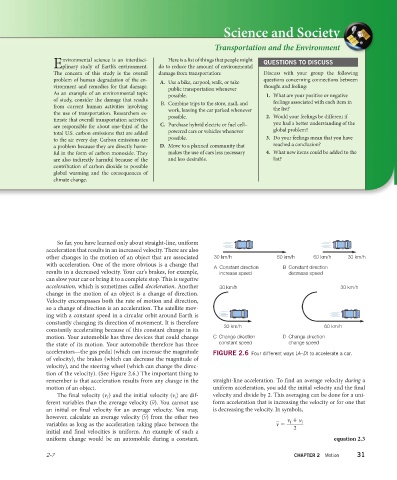
                           So far, you have learned only about straight-line, uniform
                       acceleration that results in an increased velocity. There are also
                       other changes in the motion of an object that are associated   30 km/h       60 km/h     60 km/h    30 km/h
                       with acceleration. One of the more obvious is a change that
                                                                               A Constant direction   B Constant direction
                         results in a decreased velocity. Your car’s brakes, for example,   increase speed  decrease speed
                       can slow your car or bring it to a complete stop. This is negative
                        acceleration, which is sometimes called deceleration. Another   30 km/h                          30 km/h
                       change in the motion of an object is a change of direction.
                         Velocity encompasses both the rate of motion and direction,
                       so a change of direction is an acceleration. The satellite mov-
                       ing with a constant speed in a circular orbit around Earth is
                       constantly changing its direction of movement. It is therefore
                                                                                  30 km/h                           60 km/h
                       constantly  accelerating because of this constant change in its
                       motion. Your automobile has three devices that could change   C Change direction  D Change direction
                       the state of its motion. Your automobile therefore has three   constant speed    change speed
                       accelerators—the gas pedal (which can increase the magnitude   FIGURE 2.6 Four different ways (A–D) to accelerate a car.

                       of velocity), the brakes (which can decrease the magnitude of
                       velocity), and the steering wheel (which can change the direc-
                       tion of the velocity). (See Figure 2.6.) The important thing to
                       remember is that acceleration results from any change in the   straight-line  acceleration. To find an average velocity during a
                       motion of an object.                                    uniform  acceleration, you add the initial velocity and the final
                           The final velocity (v f ) and the initial velocity (v i ) are dif-  velocity and divide by 2. This averaging can be done for a uni-
                       ferent variables than the average velocity (v) . You cannot use   form acceleration that is increasing the velocity or for one that
                       an initial or final velocity for an average velocity. You may,   is decreasing the velocity. In symbols,
                        however, calculate an average velocity (v) from the other two                  _


                       variables as long as the acceleration taking place between the               v =     v f  + v i
                                                                                                         2
                       initial and  final velocities is uniform. An example of such a
                       uniform change would be an automobile during a constant,                                        equation 2.3
                       2-7                                                                                CHAPTER 2  Motion   31

