


Page 50 - 9780077418427.pdf
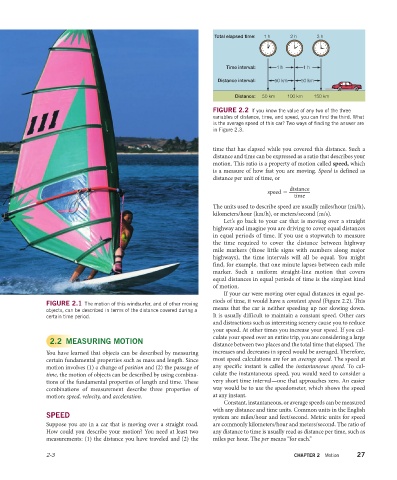
P. 50
/Users/user-f465/Desktop
          tiL12214_ch02_025-060.indd Page 27  9/1/10  9:55 PM user-f465
          tiL12214_ch02_025-060.indd Page 27  9/1/10  9:55 PM user-f465                                                 /Users/user-f465/Desktop


                                                                               Total elapsed time:  1 h  2 h     3 h


                                                                                   Time interval:   1 h      1 h

                                                                                Distance interval:  50 km   50 km

                                                                                      Distance:  50 km  100 km  150 km

                                                                               FIGURE 2.2 If you know the value of any two of the three

                                                                               variables of distance, time, and speed, you can find the third. What
                                                                               is the average speed of this car? Two ways of finding the answer are
                                                                               in Figure 2.3.


                                                                               time that has elapsed while you covered this distance. Such a
                                                                               distance and time can be expressed as a ratio that describes your
                                                                               motion. This ratio is a property of motion called speed, which
                                                                               is a measure of how fast you are moving. Speed is defined as
                                                                               distance per unit of time, or
                                                                                                        _
                                                                                                        distance

                                                                                                 speed =
                                                                                                          time
                                                                               The units used to describe speed are usually miles/hour (mi/h),
                                                                               kilometers/hour (km/h), or meters/second (m/s).
                                                                                  Let’s go back to your car that is moving over a straight
                                                                               highway and imagine you are driving to cover equal distances
                                                                               in equal periods of time. If you use a stopwatch to measure
                                                                               the time required to cover the distance between highway
                                                                               mile markers (those little signs with numbers along major
                                                                               highways), the time intervals will all be equal. You might
                                                                               find, for example, that one minute lapses between each mile
                                                                               marker. Such a uniform straight-line motion that covers
                                                                               equal  distances in equal periods of time is the simplest kind
                                                                               of  motion.
                                                                                  If your car were moving over equal distances in equal pe-
                                                                               riods of time, it would have a constant speed (Figure 2.2). This
                       FIGURE 2.1  The motion of this windsurfer, and of other moving
                       objects, can be described in terms of the distance covered during a   means that the car is neither speeding up nor slowing down.
                       certain time period.                                    It is usually difficult to maintain a constant speed. Other cars
                                                                               and distractions such as interesting scenery cause you to reduce
                                                                               your speed. At other times you increase your speed. If you cal-
                                                                               culate your speed over an entire trip, you are considering a large
                         2.2 MEASURING MOTION
                                                                               distance between two places and the total time that elapsed. The
                       You have learned that objects can be described by measuring   increases and decreases in speed would be averaged. Therefore,
                       certain fundamental properties such as mass and length. Since   most speed calculations are for an average speed. The speed at
                       motion involves (1) a change of position and (2) the passage of   any specific instant is called the  instantaneous speed. To cal-
                       time, the motion of objects can be described by using combina-  culate the instantaneous speed, you would need to consider a
                       tions of the fundamental properties of length and time. These   very short time interval—one that approaches zero. An easier
                       combinations of measurement describe three properties of   way would be to use the speedometer, which shows the speed
                        motion: speed, velocity, and acceleration.             at any instant.
                                                                                  Constant, instantaneous, or average speeds can be measured
                                                                               with any distance and time units. Common units in the English
                       SPEED                                                   system are miles/hour and feet/second. Metric units for speed
                       Suppose you are in a car that is moving over a straight road.   are commonly kilometers/hour and meters/second. The ratio of
                       How could you describe your motion? You need at least two   any distance to time is usually read as distance per time, such as
                       measurements: (1) the distance you have traveled and (2) the   miles per hour. The per means “for each.”

                       2-3                                                                                CHAPTER 2  Motion   27

