


Page 53 - 9780077418427.pdf
P. 53
/Users/user-f465/Desktop
tiL12214_ch02_025-060.indd Page 30 9/1/10 9:55 PM user-f465
tiL12214_ch02_025-060.indd Page 30 9/1/10 9:55 PM user-f465 /Users/user-f465/Desktop
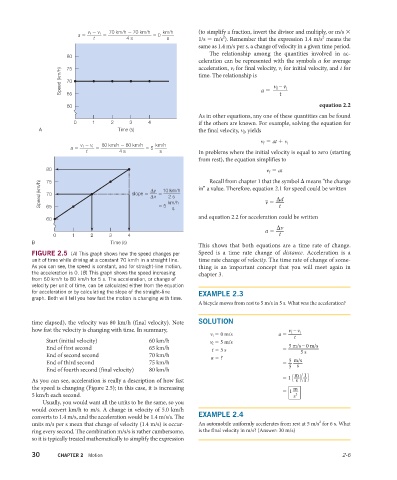
v f v i 70 km/h 70 km/h km/h (to simplify a fraction, invert the divisor and multiply, or m/s ×
a 0 2 2
t 4 s s 1/s = m/s ). Remember that the expression 1.4 m/s means the
same as 1.4 m/s per s, a change of velocity in a given time period.
The relationship among the quantities involved in ac-
80
celeration can be represented with the symbols a for average
ac celeration, v f for final velocity, v i for initial velocity, and t for
75
Speed (km/h) 70 time. The relationship is a = _
v f – v i
65
60 t equation 2.2
As in other equations, any one of these quantities can be found
0 1 2 3 4 if the others are known. For example, solving the equation for
A Time (s) the final velocity, v f , yields
v f = at + v i
80 km/h 60 km/h km/h
v f v i
a 5
t 4 s s In problems where the initial velocity is equal to zero (starting
from rest), the equation simplifies to
80 Recall from chapter 1 that the symbol Δ means “the change
v f = at
Speed (km/h) 75 slope in” a value. Therefore, equation 2.1 for speed could be written
Δy
10 km/h
70
Δx
2 s
Δd _
v =
km/h
t
5
65
s
and equation 2.2 for acceleration could be written
60
Δv _
a =
0 1 2 3 4 t
B Time (s)
This shows that both equations are a time rate of change.
FIGURE 2.5 (A) This graph shows how the speed changes per Speed is a time rate change of distance. Acceleration is a
unit of time while driving at a constant 70 km/h in a straight line. time rate change of velocity. The time rate of change of some-
As you can see, the speed is constant, and for straight-line motion, thing is an important concept that you will meet again in
the acceleration is 0. (B) This graph shows the speed increasing chapter 3.
from 60 km/h to 80 km/h for 5 s. The acceleration, or change of
velocity per unit of time, can be calculated either from the equation
for acceleration or by calculating the slope of the straight-line EXAMPLE 2.3
graph. Both will tell you how fast the motion is changing with time.
A bicycle moves from rest to 5 m/s in 5 s. What was the acceleration?
time elapsed), the velocity was 80 km/h (final velocity). Note SOLUTION
how fast the velocity is changing with time. In summary, _
v f – v i
v i = 0 m/s a = t
Start (initial velocity) 60 km/h v f = 5 m/s
5 m/s – 0 m/s
End of first second 65 km/h t = 5 s = __
5 s
End of second second 70 km/h
a = ?
_
5 _ m/s
End of third second 75 km/h =
5 s
End of fourth second (final velocity) 80 km/h
m _ 1 _
= 1 ( ) ( )
As you can see, acceleration is really a description of how fast s s
the speed is changing (Figure 2.5); in this case, it is increasing = 1
m _
5 km/h each second. s 2
Usually, you would want all the units to be the same, so you
would convert km/h to m/s. A change in velocity of 5.0 km/h
converts to 1.4 m/s, and the acceleration would be 1.4 m/s/s. The EXAMPLE 2.4
2
units m/s per s mean that change of velocity (1.4 m/s) is occur- An automobile uniformly accelerates from rest at 5 m/s for 6 s. What
ring every second. The combination m/s/s is rather cumbersome, is the final velocity in m/s? (Answer: 30 m/s)
so it is typically treated mathematically to simplify the expression
30 CHAPTER 2 Motion 2-6

