


Page 549 - 9780077418427.pdf
P. 549
/Volume/201/MHDQ233/tat78194_disk1of1/0073378194/tat78194_pagefiles
          tiL12214_ch21_521-540.indd Page 526  9/23/10  11:09 AM user-f465
          tiL12214_ch21_521-540.indd Page 526  9/23/10  11:09 AM user-f465             /Volume/201/MHDQ233/tat78194_disk1of1/0073378194/tat78194_pagefile


                      The understanding of geologic processes has been made
                   possible through the development of various means of measur-
                   ing ages and time spans in geologic systems. An understanding                 Water
                   of geologic time leads to an understanding of geologic processes,
                   which then leads to an understanding of the environmental
                   conditions that must have existed in the past. Thus, the mineral
                   composition, texture, and sedimentary structure of rocks are
                   clues to past events, events that make up the history of Earth.

                                                                            A
                   ARRANGING EVENTS IN ORDER
                   The clues provided by thinking about geologic processes that
                   must have occurred in the past are interpreted within a logical               Water
                   frame of reference that can be described by several basic princi-
                   ples. The following is a summary of these basic guiding principles
                   that are used to read a story of geologic events from the rocks.
                      Recall that the cornerstone of the logic used to guide thinking
                   about geologic time is the principle of uniformity. As  described   Irregular bottom
                   in chapter 19, this principle is sometimes stated as “the present is   surface
                   the key to the past.” This means that the geologic features that you   B
                   see today have been formed in the past by the same processes of
                   crustal movement, erosion, and deposition that are observed to-  FIGURE 21.7  The principle of original horizontality. (A) Sedi-
                   day. By studying the processes now shaping Earth, you can under-  ments tend to be deposited in horizontal layers. (B) Even where the
                   stand how it has evolved through time. This principle establishes   sediments are draped over an irregular surface, they tend toward
                   the understanding that the surface of Earth has been continuously   the horizontal.
                   and gradually modified over the immense span of geologic time.
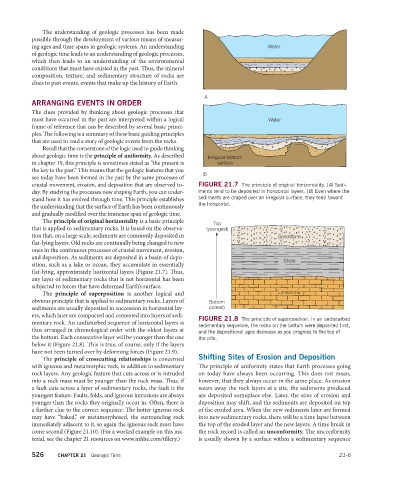
                      The principle of original horizontality is a basic principle   Top
                   that is applied to sedimentary rocks. It is based on the observa-  (youngest)
                   tion that, on a large scale, sediments are commonly deposited in                 Sandstone
                   flat-lying layers. Old rocks are continually being changed to new
                   ones in the continuous processes of crustal movement, erosion,
                   and deposition. As sediments are deposited in a basin of depo-                     Shale
                   sition, such as a lake or ocean, they accumulate in essentially
                   flat-lying, approximately horizontal layers (Figure 21.7). Thus,
                   any layer of sedimentary rocks that is not horizontal has been
                   subjected to forces that have  deformed Earth’s surface.
                      The  principle of superposition is another logical and                        Limestone
                     obvious principle that is applied to sedimentary rocks. Layers of   Bottom
                   sediments are usually deposited in succession in horizon tal lay-  (oldest)
                   ers, which later are compacted and cemented into layers of sedi-
                                                                          FIGURE 21.8  The principle of superposition. In an undisturbed
                   mentary rock. An undisturbed sequence of horizontal layers is
                                                                          sedimentary sequence, the rocks on the bottom were deposited first,
                   thus arranged in chronological order with the oldest layers at   and the depositional ages decrease as you progress to the top of
                   the bottom. Each consecutive layer will be younger than the one   the pile.
                   below it (Figure 21.8). This is true, of course, only if the  layers
                   have not been turned over by deforming forces (Figure 21.9).
                      The principle of crosscutting relationships is concerned   Shifting Sites of Erosion and Deposition
                   with igneous and metamorphic rock, in addition to sedimentary   The principle of uniformity states that Earth processes going
                   rock layers. Any geologic feature that cuts across or is  intruded   on today have always been occurring. This does not mean,
                   into a rock mass must be younger than the rock mass. Thus, if   however, that they always occur in the same place. As erosion
                   a fault cuts across a layer of sedimentary rocks, the fault is the   wears away the rock layers at a site, the sediments produced
                   youngest feature. Faults, folds, and igneous intrusions are always   are  deposited someplace else. Later, the sites of erosion and
                   younger than the rocks they originally occur in. Often, there is   deposition may shift, and the sediments are deposited on top
                   a further clue to the correct sequence: The hotter igneous rock   of the eroded area. When the new sediments later are formed
                   may have “baked,” or metamorphosed, the surrounding rock   into new sedimentary rocks, there will be a time lapse between
                     immediately adjacent to it, so again the igneous rock must have   the top of the eroded layer and the new layers. A time break in
                   come second (Figure 21.10). (For a worked example on this ma-  the rock record is called an unconformity. The unconformity
                   terial, see the chapter 21 resources on www.mhhe.com/tillery.)  is usually shown by a surface within a sedimentary  sequence

                   526     CHAPTER 21 Geologic Time                                                                     21-6

