


Page 612 - 9780077418427.pdf
P. 612
/Volume/201/MHDQ233/tat78194_disk1of1/0073378194/tat78194_pagefiles
          tiL12214_ch23_565-596.indd Page 589  9/23/10  11:07 AM user-f465
          tiL12214_ch23_565-596.indd Page 589  9/23/10  11:07 AM user-f465             /Volume/201/MHDQ233/tat78194_disk1of1/0073378194/tat78194_pagefile


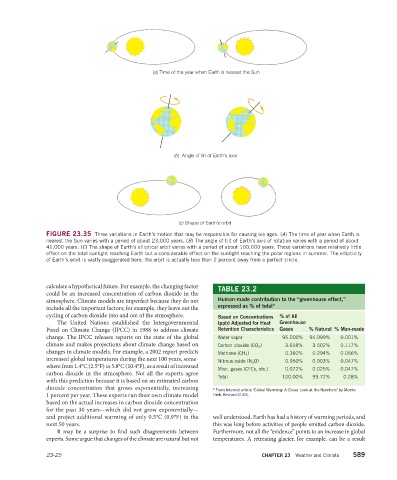
                                                           (a) Time of the year when Earth is nearest the Sun


                                                                  (b)  Angle of tilt of Earth’s axis


                                                                   (c) Shape of Earth’s orbit

                       FIGURE 23.35  Three variations in Earth’s motion that may be responsible for causing ice ages. (A) The time of year when Earth is
                       nearest the Sun varies with a period of about 23,000 years. (B) The angle of tilt of Earth’s axis of rotation varies with a period of about
                       41,000 years. (C) The shape of Earth’s elliptical orbit varies with a period of about 100,000 years. These variations have relatively little
                       effect on the total sunlight reaching Earth but a considerable effect on the sunlight reaching the polar regions in summer. The ellipticity
                       of Earth’s orbit is vastly exaggerated here; the orbit is actually less than 2 percent away from a perfect circle.


                         calculate a hypothetical future. For example, the changing factor   TABLE 23.2
                       could be an increased concentration of carbon dioxide in the
                         atmosphere. Climate models are imperfect because they do not   Human-made contribution to the “greenhouse effect,”
                       include all the important factors; for example, they leave out the   expressed as % of total*
                       cycling of carbon dioxide into and out of the atmosphere.  Based on Concentrations  % of All
                           The United Nations established the Intergovernmental   (ppb) Adjusted for Heat  Greenhouse
                       Panel on Climate Change (IPCC) in 1988 to address climate   Retention Characteristics  Gases  % Natural % Man-made
                       change. The IPCC releases reports on the state of the global   Water vapor      95.000%   94.999%     0.001%
                       climate and makes projections about climate change based on   Carbon dioxide (CO 2 )      3.618%     3.502%     0.117%
                       changes in  climate models. For example, a 2002 report predicts   Methane (CH 4 )      0.360%     0.294%     0.066%
                       increased global temperatures during the next 100 years, some-  Nitrous oxide (N 2 O)      0.950%     0.903%     0.047%
                       where from 1.4°C (2.5°F) to 5.8°C (10.4°F), as a result of increased
                                                                                Misc. gases (CFCs, etc.)      0.072%     0.025%     0.047%
                       carbon dioxide in the atmosphere. Not all the experts agree
                                                                                Total                  100.00%     99.72%       0.28%
                       with this prediction because it is based on an estimated carbon
                       dioxide concentration that grows exponentially, increasing   * From Internet article “Global Warming: A Closer Look at the Numbers” by Monte
                       1 percent per year. These experts run their own climate model   Hieb. Revised 01/03.
                       based on the actual increases in carbon dioxide concentration
                       for the past 30 years—which did not grow exponentially—
                       and project additional warming of only 0.5°C (0.9°F) in the   well understood. Earth has had a history of warming periods, and
                       next 50 years.                                          this was long before activities of people emitted carbon dioxide.
                           It may be a surprise to find such disagreements between   Furthermore, not all the “evidence” points to an increase in global
                         experts. Some argue that changes of the climate are natural but not   temperatures. A retreating glacier, for example, can be a  result

                       23-25                                                                   CHAPTER 23  Weather and Climate   589

