


Page 610 - 9780077418427.pdf
P. 610
/Volume/201/MHDQ233/tat78194_disk1of1/0073378194/tat78194_pagefiles
          tiL12214_ch23_565-596.indd Page 587  9/23/10  11:07 AM user-f465
          tiL12214_ch23_565-596.indd Page 587  9/23/10  11:07 AM user-f465             /Volume/201/MHDQ233/tat78194_disk1of1/0073378194/tat78194_pagefile


                         23.4 CLIMATE CHANGE                                       1
                       As stated earlier, weather describes changes in the atmospheric
                       condition (rain, wind, etc.) over a brief period of time (day, week).   0.5
                       Climate describes the general pattern of weather that occurs over
                       a region for a number of months or years. Climate change is   0
                       a departure from the expected average pattern of climate for a   Change in temperature (  o c)
                       region over time. Scientists have measured climate patterns dur-
                       ing the past 120 years or so by using thermometers, rain gauges,   –0.5
                       and other instruments. Climate patterns before 120 years ago are
                       inferred by analyzing evidence found in tree rings, lake-bottom   –1
                       sediments, ice cores drilled from a glacier, and other sources.   1000  1200   1400    1600    1800   2000
                       A natural source used to infer temperature change, rainfall, or                 Year ( A.D.)
                       some other past climate condition is called proxy data.
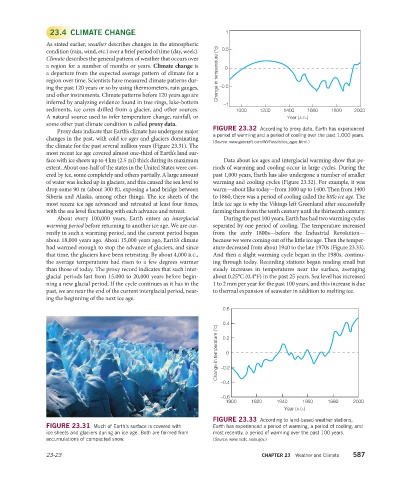
                                                                               FIGURE 23.32  According to proxy data, Earth has  experienced
                           Proxy data indicate that Earth’s climate has undergone major
                                                                               a period of warming and a period of cooling over the past 1,000 years.
                       changes in the past, with cold ice ages and glaciers dominating
                                                                               (Source: www.geocraft.com/WVFossils/ice_ages.html.)
                       the climate for the past several million years (Figure 23.31). The
                       most recent ice age covered almost one-third of Earth’s land sur-
                       face with ice sheets up to 4 km (2.5 mi) thick during its maximum   Data about ice ages and interglacial warming show that pe-
                       extent. About one-half of the states in the United States were cov-  riods of warming and cooling occur in large cycles. During the
                       ered by ice, some completely and others partially. A large amount   past 1,000 years, Earth has also undergone a number of smaller
                       of water was locked up in glaciers, and this caused the sea level to   warming and cooling cycles (Figure 23.32). For example, it was
                       drop some 90 m (about 300 ft), exposing a land bridge between   warm—about like today—from 1000 up to 1400. Then from 1400
                       Siberia and Alaska, among other things. The ice sheets of the   to 1860, there was a period of cooling called the little ice age. The
                       most recent ice age advanced and retreated at least four times,   little ice age is why the Vikings left Greenland after successfully
                       with the sea level fluctuating with each advance and retreat.  farming there from the tenth century until the thirteenth century.
                           About every 100,000 years, Earth enters an  interglacial   During the past 100 years, Earth has had two warming cycles
                       warming period before returning to another ice age. We are cur-  separated by one period of cooling. The temperature increased
                       rently in such a warming period, and the current period began   from the early 1800s—before the Industrial  Revolution—
                       about 18,000 years ago. About 15,000 years ago, Earth’s climate   because we were coming out of the little ice age. Then the temper-
                       had warmed enough to stop the advance of glaciers, and since   ature decreased from about 1940 to the late 1970s ( Figure 23.33).
                       that time, the glaciers have been retreating. By about 4,000 b.c.,   And then a slight warming cycle began in the 1980s, continu-
                       the average temperatures had risen to a few degrees warmer   ing through today. Recording stations began reading small but
                       than those of today. The proxy record indicates that such inter-  steady increases in temperatures near the surface, averaging
                       glacial periods last from 15,000 to 20,000 years before begin-  about 0.25°C (0.4°F) in the past 25 years. Sea level has increased
                       ning a new glacial period. If the cycle continues as it has in the   1 to 2 mm per year for the past 100 years, and this increase is due
                       past, we are near the end of the current interglacial period, near-  to thermal expansion of seawater in addition to melting ice.
                       ing the beginning of the next ice age.
                                                                                  0.6

                                                                                  0.4
                                                                                Change in temperature (  o c)  –0.2
                                                                                  0.2

                                                                                   0


                                                                                 –0.4

                                                                                 –0.6
                                                                                   1900    1920     1940    1960     1980    2000
                                                                                                      Year ( A.D.)

                                                                               FIGURE 23.33  According to land-based weather stations,
                        FIGURE 23.31  Much of Earth’s surface is covered with   Earth has experienced a period of warming, a period of cooling, and
                        ice sheets and glaciers during an ice age. Both are formed from   most recently, a period of warming over the past 100 years.
                          accumulations of compacted snow.                     (Source: www.ncdc.noaa.gov.)

                       23-23                                                                   CHAPTER 23  Weather and Climate   587

