


Page 613 - 9780077418427.pdf
P. 613
/Volume/201/MHDQ233/tat78194_disk1of1/0073378194/tat78194_pagefiles
          tiL12214_ch23_565-596.indd Page 590  9/23/10  11:07 AM user-f465
          tiL12214_ch23_565-596.indd Page 590  9/23/10  11:07 AM user-f465             /Volume/201/MHDQ233/tat78194_disk1of1/0073378194/tat78194_pagefile


                           People Behind the Science


                           Vilhelm Firman Koren Bjerknes (1862–1951)

                         ilhelm Bjerknes was the Norwegian sci-                            his coworkers to develop the highly influ-
                     Ventist who created modern meteorology.                               ential theory of polar fronts, on the basis
                        Bjerknes came from a talented family.                              of the discovery that the atmosphere is
                     His father was professor of mathematics at                            made up of discrete air masses display-
                     the Christiania (now Oslo) University and                             ing dissimilar  features. Bjerknes coined
                     a highly influential geophysicist who clearly                         the word front to delineate the boundar-
                     shaped his son’s studies. Bjerknes held chairs                        ies between such air masses. One of the
                     at Stockholm and Leipzig before founding                              many contributions of the “Bergen fron-
                     the Bergen Geophysical Institute in 1917.                             tal theory” was to explain the genera-
                     By developing hydrodynamic models of the                              tion of cyclones over the Atlantic, at the
                     oceans and the atmosphere, Bjerknes made                              junction of warm and cold air wedges.
                     momentous contributions that transformed                              Bjerknes’s work gave modern meteorol-
                     meteorology into an accepted science. Not   During World War I, Bjerknes in-  ogy its theoretical tools and methods of
                     least, he showed how weather prediction   stituted a network of weather stations   investigation.
                     could be put on a statistical basis, depen-  throughout Norway; coordination of the
                     dent on the use of mathematical models.  findings from such stations led him and


                   Source: From the Hutchinson Dictionary of Scientific Biography. © Research Machines plc 2003. All Rights Reserved. Helicon Publishing is a division of Research Machines.


                                          370
                                          360
                                          350
                                        CO 2  concentration, ppm  330
                                          340


                                          320
                                          310
                                          300
                                          290

                                          280
                                                 1870    1890     1910    1930    1950    1970    1990
                                                                         Year

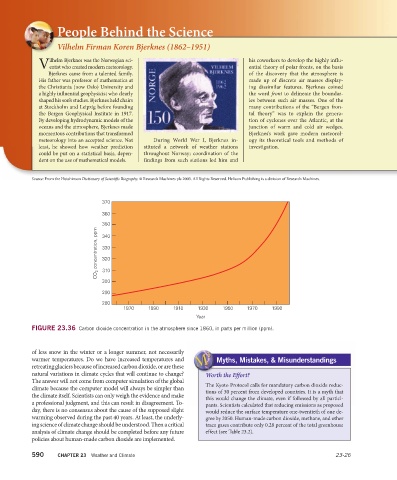
                   FIGURE 23.36  Carbon dioxide concentration in the atmosphere since 1860, in parts per million (ppm).


                   of less snow in the winter or a longer summer, not  necessarily
                   warmer temperatures. Do we have increased temperatures and   Myths, Mistakes, & Misunderstandings
                       retreating glaciers because of increased carbon dioxide, or are these
                   natural variations in climate cycles that will continue to change?   Worth the Effort?
                   The answer will not come from computer simulation of the global
                                                                            The Kyoto Protocol calls for mandatory carbon dioxide reduc-
                   climate because the computer model will always be simpler than
                                                                            tions of 30 percent from developed countries. It is a myth that
                   the climate itself. Scientists can only weigh the evidence and make
                                                                            this would change the climate, even if followed by all partici-
                   a professional judgment, and this can result in disagreement. To-  pants. Scientists calculated that reducing emissions as proposed
                   day, there is no consensus about the cause of the supposed slight   would reduce the surface temperature one-twentieth of one de-
                   warming observed during the past 40 years. At least, the underly-  gree by 2050. Human-made carbon dioxide, methane, and other
                   ing science of climate change should be understood. Then a critical   trace gases contribute only 0.28 percent of the total greenhouse
                   analysis of climate change should be completed before any future   effect (see Table 23.2).
                   policies about human-made carbon dioxide are implemented.

                   590     CHAPTER 23  Weather and Climate                                                             23-26

