


Page 611 - 9780077418427.pdf
P. 611
/Volume/201/MHDQ233/tat78194_disk1of1/0073378194/tat78194_pagefile
          tiL12214_ch23_565-596.indd Page 588  9/23/10  11:07 AM user-f465
          tiL12214_ch23_565-596.indd Page 588  9/23/10  11:07 AM user-f465             /Volume/201/MHDQ233/tat78194_disk1of1/0073378194/tat78194_pagefiles


                      The recent temperature increase is not uniform around the   to 0.2 percent with each sunspot cycle. If this increase continues
                   globe since the southeastern United States has cooled over the   into the mid-twenty-first century, Earth’s surface temperature
                   past 100 years. Arctic sea ice has decreased since the early 1970s,   will increase by about 0.5°C (about 1°F). However, a relationship
                   but sea ice in the Antarctic has increased during the same period.   between the sunspot cycle length and temperatures also comes
                   Nonetheless, some people became concerned that the temperature   into play. Higher-than-normal temperatures tend to occur with
                   increase was caused by the release of greenhouse gases—mostly   shorter cycles, and lower-than-normal temperatures occur with
                   carbon dioxide—and would result in a runaway  greenhouse effect   longer cycles.
                   (see p. 546 for information on the greenhouse effect).    In addition to changes in the Sun, changes in the orientation
                                                                          of Earth’s tilt, orbital shape, and axis wobble alter our orientation
                                                                          to the Sun in predictable cycles. These are called  Milankovitch
                   CAUSES OF GLOBAL CLIMATE CHANGE
                                                                          cycles after Milutin Milankovitch (1879–1958), a Yugoslav
                   Climate change is brought about by a complex interaction of a   physicist who calculated how the cycles would affect the cli-
                   number of factors. Some of these factors could be astronomical,   mate by altering the amount of solar energy received by Earth
                   and others could be occurring in the atmosphere. Solar energy   ( Figure 23.35). As it works out, the amount of energy  received
                   is fundamentally responsible for weather and climate, and   by high latitudes varies up to 20 percent. A shorter  summer al-
                   changes in the Sun’s energy output can change the climate. The   lows ice to accumulate, making an ice age. The  timing of the ice
                   Sun’s output of energy changes with sunspots, dark spots that   age and cycles of warmer or cooler average temperatures fit with
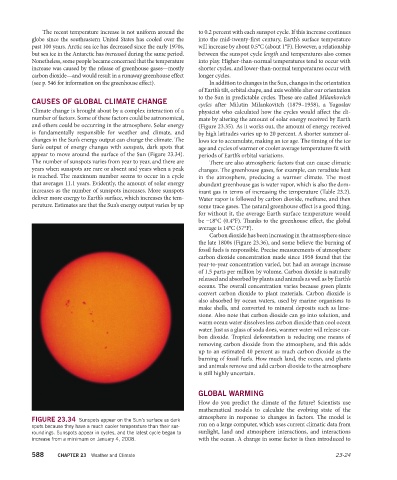
                   appear to move around the surface of the Sun (Figure 23.34).   periods of Earth’s orbital variations.
                   The number of sunspots varies from year to year, and there are   There are also atmospheric factors that can cause climatic
                   years when sunspots are rare or absent and years when a peak   changes. The greenhouse gases, for example, can reradiate heat
                   is reached. The maximum number seems to occur in a cycle   in the atmosphere, producing a warmer climate. The most
                   that averages 11.1 years. Evidently, the amount of solar energy   abundant greenhouse gas is water vapor, which is also the dom-
                   increases as the number of sunspots increases. More sunspots   inant gas in terms of increasing the temperature (Table 23.2).
                   deliver more energy to Earth’s surface, which increases the tem-  Water vapor is followed by carbon dioxide, methane, and then
                   perature. Estimates are that the Sun’s energy output varies by up   some trace gases. The natural greenhouse effect is a good thing,
                                                                          for without it, the average Earth surface temperature would
                                                                          be –18°C (0.4°F). Thanks to the greenhouse effect, the global
                                                                          average is 14°C (57°F).
                                                                             Carbon dioxide has been increasing in the atmosphere since
                                                                          the late 1800s (Figure 23.36), and some believe the  burning of
                                                                          fossil fuels is responsible. Precise measurements of atmosphere
                                                                          carbon dioxide concentration made since 1958 found that the
                                                                          year-to-year concentration varied, but had an average increase
                                                                          of 1.5 parts per million by volume. Carbon dioxide is naturally
                                                                          released and absorbed by plants and animals as well as by Earth’s
                                                                          oceans. The overall concentration varies because green plants
                                                                          convert carbon dioxide to plant materials. Carbon dioxide is
                                                                          also absorbed by ocean waters, used by marine organisms to
                                                                          make shells, and converted to mineral deposits such as lime-
                                                                          stone. Also note that carbon dioxide can go into solution, and
                                                                          warm ocean water dissolves less carbon dioxide than cool ocean
                                                                          water. Just as a glass of soda does, warmer water will release car-
                                                                          bon dioxide. Tropical deforestation is reducing one means of
                                                                          removing carbon dioxide from the atmosphere, and this adds
                                                                          up to an estimated 40 percent as much carbon dioxide as the
                                                                          burning of fossil fuels. How much land, the ocean, and plants
                                                                          and animals remove and add carbon dioxide to the atmosphere
                                                                          is still highly uncertain.


                                                                          GLOBAL WARMING
                                                                          How do you predict the climate of the future? Scientists use
                                                                          mathematical models to calculate the evolving state of the
                                                                            atmosphere in response to changes in factors. The model is
                   FIGURE 23.34  Sunspots appear on the Sun’s surface as dark
                   spots because they have a much cooler temperature than their sur-  run on a large computer, which uses current climatic data from
                   roundings. Sunspots appear in cycles, and the latest cycle began to   sunlight, land and atmosphere interactions, and interactions
                   increase from a minimum on January 4, 2008.            with the ocean. A change in some factor is then introduced to

                   588     CHAPTER 23  Weather and Climate                                                             23-24

