Page 69 - 9780077418427.pdf
P. 69

/Users/user-f465/Desktop
          tiL12214_ch02_025-060.indd Page 46  9/1/10  9:55 PM user-f465
          tiL12214_ch02_025-060.indd Page 46  9/1/10  9:55 PM user-f465                                                 /Users/user-f465/Desktop


                   before you can apply F = ma. The only forces that will affect the   where one side is moving toward victory and it is difficult to
                   forward motion of the bike system are the force of the ground   stop. It seems appropriate to borrow this term from the physi-
                   pushing it forward and the frictional forces that oppose the for-  cal sciences because momentum is a property of movement. It
                   ward motion. This is another example of the third law.  takes a longer time to stop something from moving when it has
                                                                          a lot of momentum. The physical science concept of momen-
                                                                          tum is closely related to Newton’s laws of motion. Momentum
                   EXAMPLE 2.12
                                                                          (p) is defined as the product of the mass (m) of an object and
                   A 60.0 kg astronaut is freely floating in space and pushes on a freely   its velocity (v),
                   floating 120.0 kg spacecraft with a force of 30.0 N for 1.50 s. (a) Compare
                   the forces exerted on the astronaut and the spacecraft, and (b) compare   momentum = mass × velocity
                   the acceleration of the astronaut to the  acceleration of the spacecraft.
                                                                          or
                                                                                                p = mv
                   SOLUTION
                                                                                                                  equation 2.8
                   (a)  According to Newton’s third law of motion (equation 2.7),
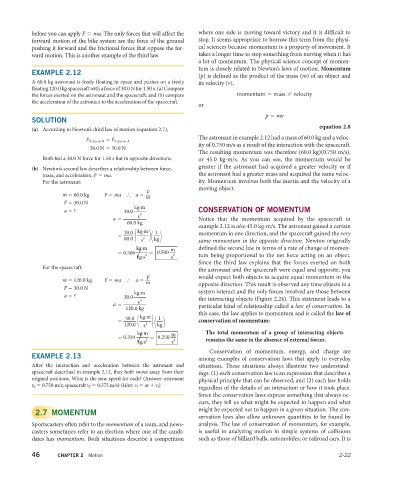
                                                                          The astronaut in example 2.12 had a mass of 60.0 kg and a veloc-
                                     F A due to B  = F B due to A
                                                                          ity of 0.750 m/s as a result of the interaction with the spacecraft.
                                      30.0 N = 30.0 N
                                                                          The resulting momentum was therefore  (60.0 kg)(0.750 m/s),
                      Both feel a 30.0 N force for 1.50 s but in opposite directions.  or 45.0 kg⋅m/s. As you can see, the momentum would be
                                                                          greater if the astronaut had acquired a greater velocity or if
                   (b)   Newton’s second law describes a relationship between force,
                      mass, and acceleration, F = ma.                     the astronaut had a greater mass and acquired the same veloc-
                      For the astronaut:                                  ity. Momentum involves both the inertia and the velocity of a
                                                                          moving object.
                                                         F _
                             m = 60.0 kg   F = ma  ∴  a =
                                                        m
                             F = 30.0 N
                                                     kg·m
                                                    _

                             a = ?               30.0                     CONSERVATION OF MOMENTUM
                                                       2
                                                 _
                                                       s

                                              a  =                        Notice that the momentum acquired by the spacecraft in
                                                  60.0 kg
                                                                            example 2.12 is also 45.0 kg⋅m/s. The astronaut gained a certain
                                                 30.0 _ _
                                                 _    kg·m  1               momentum in one direction, and the spacecraft gained the very


                                               =    60.0( )( kg)          same momentum in the opposite direction. Newton originally


                                                        2
                                                       s
                                                     kg·m
                                                     _           m _      defined the second law in terms of a rate of change of momen-


                                               = 0.500             =   0.500
                                                     kg·s 2      s 2      tum being proportional to the net force acting on an object.
                                                                          Since the third law explains that the forces exerted on both
                      For the spacecraft:
                                                                          the astronaut and the spacecraft were equal and opposite, you
                                                         F _
                             m = 120.0 kg   F = ma  ∴  a =                would expect both objects to acquire equal momentum in the
                                                        m
                             F = 30.0 N                                   opposite direction. This result is observed any time objects in a
                                                                          system interact and the only forces involved are those between
                                                     kg·m

                             a = ?               30.0   _


                                                       2
                                                 _                        the interacting objects (Figure 2.24). This statement leads to a
                                                       s
                                              a  =                        particular kind of relationship called a law of conservation. In
                                                  120.0 kg
                                                                          this case, the law applies to momentum and is called the law of
                                                  30.0 _ _
                                                 _     kg·m  1
                                                      ( )( kg)


                                               =                                conservation of momentum:

                                                 120.0  s 2
                                                      kg·m
                                                     _           m _        The total momentum of a group of interacting objects

                                               = 0.250            =   0.250

                                                      kg·s 2     s 2        remains the same in the absence of external forces.
                                                                             Conservation of momentum, energy, and charge are
                   EXAMPLE 2.13
                                                                          among examples of conservation laws that apply to everyday
                   After the interaction and acceleration between the astronaut and   situations. These situations always illustrate two understand-
                     spacecraft described in example 2.12, they both move away from their   ings: (1) each conservation law is an expression that describes a
                     original positions. What is the new speed for each? (Answer: astronaut
                                                                          physical principle that can be observed, and (2) each law holds
                   v f  = 0.750 m/s; spacecraft v f  = 0.375 m/s) (Hint: v f  = at + v i )
                                                                          regardless of the details of an interaction or how it took place.
                                                                          Since the conservation laws express something that always oc-
                                                                          curs, they tell us what might be expected to  happen and what
                                                                          might be expected not to happen in a given situation. The con-
                    2.7 MOMENTUM
                                                                          servation laws also allow unknown quantities to be found by
                     Sportscasters often refer to the momentum of a team, and news-  analysis. The law of conservation of momentum, for example,
                   casters sometimes refer to an election where one of the candi-  is useful in analyzing motion in simple systems of collisions
                   dates has momentum. Both situations describe a competition   such as those of billiard balls, automobiles, or railroad cars. It is
                   46      CHAPTER 2 Motion                                                                             2-22
   64   65   66   67   68   69   70   71   72   73   74