


Page 291 - HOW TO PROVE IT: A Structured Approach, Second Edition
P. 291
P1: Oyk/
                   0521861241c06  CB996/Velleman  October 20, 2005  1:8  0 521 86124 1  Char Count= 0


                                                     More Examples                     277
                                (c) Suppose that n 0 ≥ 2 and the arithmetic-geometric mean inequality
                                    fails for some list of length n 0 . In other words, there are positive real
                                                       such that
                                    numbers a 1 , a 2 , . .., a n 0
                                                                   √
                                                a 1 + a 2 +· · · + a n 0
                                                                <  n 0 a 1 a 2 ··· a n 0 .
                                                      n 0
                                    Prove that for all n ≥ n 0 , the arithmetic-geometric mean inequality
                                    fails for some list of length n.
                                (d) Prove that the arithmetic-geometric mean inequality always holds.
                              9. Prove that if n ≥ 2 and a 1 , a 2 ,. . . , a n is a list of positive real numbers,
                                then
                                                      n          √
                                                               ≤  n  a 1 a 2 ··· a n .
                                               1    1        1
                                                 +   +· · · +
                                               a 1  a 2     a n
                                (Hint: Apply exercise 8. The number on the left side of the inequality
                                above is called the harmonic mean of the numbers a 1 , a 2 , . .., a n .)
                            ∗                                                    n
                             10. Prove that for every set A,if A has n elements then P (A) has 2 elements.
                             11. If A is a set, let P 2 (A) be the set of all subsets of A that have exactly two
                                elements. Prove that for every set A,if A has n elements then P 2 (A) has
                                n(n − 1)/2 elements. (Hint: See the solution for exercise 10.)
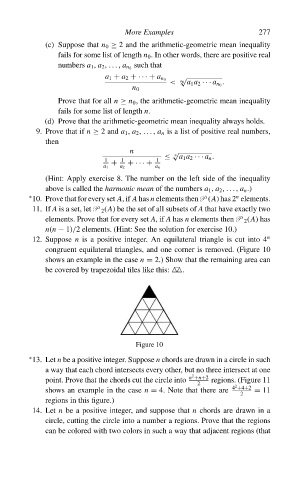
                             12. Suppose n is a positive integer. An equilateral triangle is cut into 4 n
                                congruent equilateral triangles, and one corner is removed. (Figure 10
                                shows an example in the case n = 2.) Show that the remaining area can
                                be covered by trapezoidal tiles like this:   .


                                                       Figure 10
                             13. Let n be a positive integer. Suppose n chords are drawn in a circle in such
                            ∗
                                a way that each chord intersects every other, but no three intersect at one
                                                                      2
                                point. Prove that the chords cut the circle into  n +n+2  regions. (Figure 11
                                                                       2         2
                                shows an example in the case n = 4. Note that there are  4 +4+2  = 11
                                                                                  2
                                regions in this figure.)
                             14. Let n be a positive integer, and suppose that n chords are drawn in a
                                circle, cutting the circle into a number a regions. Prove that the regions
                                can be colored with two colors in such a way that adjacent regions (that

