


Page 287 - HOW TO PROVE IT: A Structured Approach, Second Edition
P. 287
P1: Oyk/
                   0521861241c06  CB996/Velleman  October 20, 2005  1:8  0 521 86124 1  Char Count= 0


                                                     More Examples                     273
                            Solution
                                                               n
                                                                   n
                            Theorem. For any positive integer n, a 2 × 2 square grid with any one
                            square removed can be covered with L-shaped tiles.
                            Proof. We use induction on n.
                              Base case: Suppose n = 1. Then the grid is a 2 × 2 grid with one square
                            removed, which can clearly be covered with one L-shaped tile.
                              Induction step: Let n be an arbitrary positive integer, and suppose that a
                                 n
                             n
                            2 × 2 grid with any one square removed can be covered with L-shaped tiles.
                            Now consider a 2 n+1  × 2 n+1  grid with one square removed. Cut the grid in half
                                                                             n
                                                                         n
                            both vertically and horizontally, splitting it into four 2 × 2 subgrids. The
                            one square that has been removed comes from one of these subgrids, so by the
                            inductive hypothesis the rest of this subgrid can be covered with L-shaped tiles.
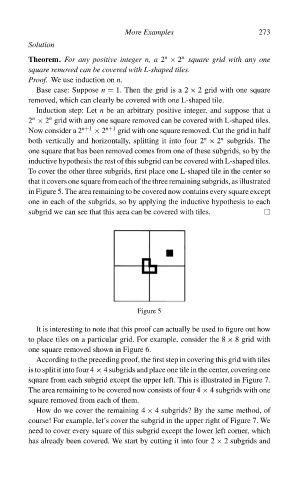
                            To cover the other three subgrids, first place one L-shaped tile in the center so
                            that it covers one square from each of the three remaining subgrids, as illustrated
                            in Figure 5. The area remaining to be covered now contains every square except
                            one in each of the subgrids, so by applying the inductive hypothesis to each
                            subgrid we can see that this area can be covered with tiles.


                                                        Figure 5

                              It is interesting to note that this proof can actually be used to figure out how
                            to place tiles on a particular grid. For example, consider the 8 × 8 grid with
                            one square removed shown in Figure 6.
                              According to the preceding proof, the first step in covering this grid with tiles
                            is to split it into four 4 × 4 subgrids and place one tile in the center, covering one
                            square from each subgrid except the upper left. This is illustrated in Figure 7.
                            The area remaining to be covered now consists of four 4 × 4 subgrids with one
                            square removed from each of them.
                              How do we cover the remaining 4 × 4 subgrids? By the same method, of
                            course! For example, let’s cover the subgrid in the upper right of Figure 7. We
                            need to cover every square of this subgrid except the lower left corner, which
                            has already been covered. We start by cutting it into four 2 × 2 subgrids and

