


Page 292 - HOW TO PROVE IT: A Structured Approach, Second Edition
P. 292
P1: Oyk/
                   0521861241c06  CB996/Velleman  October 20, 2005  1:8  0 521 86124 1  Char Count= 0


                                   278                  Mathematical Induction


                                                              Figure 11

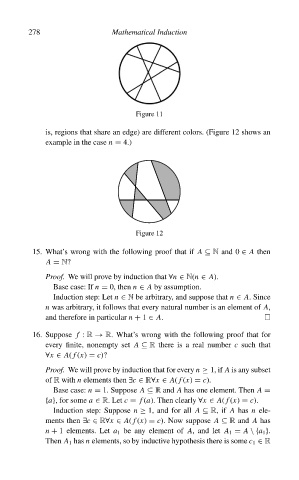
                                       is, regions that share an edge) are different colors. (Figure 12 shows an
                                       example in the case n = 4.)


                                                              Figure 12

                                    15. What’s wrong with the following proof that if A ⊆ N and 0 ∈ A then
                                       A = N?

                                       Proof. We will prove by induction that ∀n ∈ N(n ∈ A).
                                         Base case: If n = 0, then n ∈ A by assumption.
                                         Induction step: Let n ∈ N be arbitrary, and suppose that n ∈ A. Since
                                       n was arbitrary, it follows that every natural number is an element of A,
                                       and therefore in particular n + 1 ∈ A.

                                    16. Suppose f : R → R. What’s wrong with the following proof that for
                                       every finite, nonempty set A ⊆ R there is a real number c such that
                                       ∀x ∈ A( f (x) = c)?

                                       Proof. We will prove by induction that for every n ≥ 1, if A is any subset
                                       of R with n elements then ∃c ∈ R∀x ∈ A( f (x) = c).
                                         Base case: n = 1. Suppose A ⊆ R and A has one element. Then A =
                                       {a}, for some a ∈ R. Let c = f (a). Then clearly ∀x ∈ A( f (x) = c).
                                         Induction step: Suppose n ≥ 1, and for all A ⊆ R,if A has n ele-
                                       ments then ∃c ∈ R∀x ∈ A( f (x) = c). Now suppose A ⊆ R and A has
                                       n + 1 elements. Let a 1 be any element of A, and let A 1 = A \{a 1 }.
                                       Then A 1 has n elements, so by inductive hypothesis there is some c 1 ∈ R

