


Page 17 - PRE-U STPM BIOLOGY TERM 1
P. 17
Biology Term 1  STPM  Chapter 2 Structure of Cells and Organelles


                                                                                    Microfibril
                                                                                    Matrix
          2
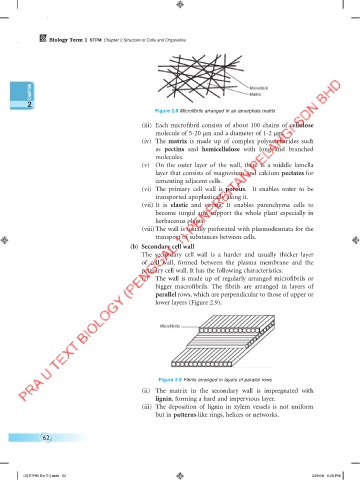
                                                    Figure 2.8 Microfibrils arranged in an amorphals matrix

                                                (iii)  Each microfibril consists of about 100 chains of cellulose
                                                     molecule of 5-20 µm and a diameter of 1-2 µm.
                                                (iv)  The  matrix is made up of complex polysaccharides such
                                                     as  pectins and  hemicellulose with long and branched
                                                     molecules.
                                                (v)  On the outer layer of the wall, there is a middle lamella
                                                     layer that consists of magnesium and calcium pectates for
                                                     cementing adjacent cells.
                                                (vi)  The primary cell wall is  porous.  It enables water to be
                                                     transported apoplastically along it.
                                                (vii) It  is  elastic  and strong. It enables parenchyma cells to
                                                     become turgid and support the whole plant especially in
                                                     herbaceous plants.
                                                (viii) The wall is usually perforated with plasmodesmata for the
                                                     transport of substances between cells.
                                            (b)  Secondary cell wall
                                                The secondary cell wall is a harder and usually thicker layer
                                                of cell wall, formed between the plasma membrane and the
                                                primary cell wall. It has the following characteristics:
                                                (i)  The wall is made up of regularly arranged microfibrils or
                                                     bigger macrofibrils. The fibrils are arranged in layers of
                                                     parallel rows, which are perpendicular to those of upper or
                                                     lower layers (Figure 2.9).


                                                      Microfibrils


                                                      Figure 2.9 Fibrils arranged in layers of parallel rows
                                                (ii)  The matrix  in  the secondary  wall  is  impregnated with
                                                     lignin, forming a hard and impervious layer.
                                                (iii)  The deposition of lignin in xylem vessels is not uniform
                                                     but in patterns like rings, helices or networks.


               62


         02[STPM Bio T1].indd   62                                                                      3/29/18   5:08 PM

