


Page 15 - PRE-U STPM BIOLOGY TERM 1
P. 15
Biology Term 1  STPM  Chapter 2 Structure of Cells and Organelles

                                                                                    Carbohydrate
                                                     Glycoprotein
                   Glycolipid
                Globular                                                                        Hydrophilic
                protein                                                                         heads
                Protein
                channel
                (Transport
          2     protein)                                                                        Phospholipid
                                                                                                bilayer
                Cholesterol

                                                                                                Phospholipid
                                                                                                molecule
                   Peripherial protein
                                   Globular protein              Surface protein  Alpha-Helix protein
                                   (integral protein)  Filaments of cytoskeleton  (Intergral protein)
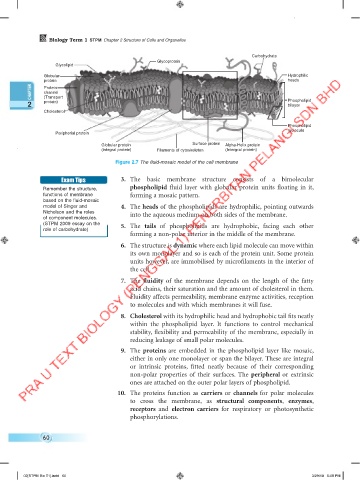
                                       Figure 2.7 The fluid-mosaic model of the cell membrane

                     Exam Tips            3.  The basic membrane structure consists of a bimolecular
                                            phospholipid fluid layer with globular protein units floating in it,
               Remember the structure,
               functions of membrane        forming a mosaic pattern.
               based on the fluid-mosaic
               model of Singer and        4.  The heads of the phospholipids are hydrophilic, pointing outwards
               Nicholson and the roles      into the aqueous medium on both sides of the membrane.
               of component molecules.
               (STPM 2009 essay on the     5.  The  tails  of phospholipids are hydrophobic, facing each other
               role of carbohydrate)
                                            forming a non-polar interior in the middle of the membrane.
                                          6.  The structure is dynamic where each lipid molecule can move within
                                            its own monolayer and so is each of the protein unit. Some protein
                                            units however, are immobilised by microfilaments in the interior of
                                            the cell.
                                          7.  The  fluidity  of the membrane depends on the length of the fatty
                                            acid chains, their saturation and the amount of cholesterol in them.
                                            Fluidity affects permeability, membrane enzyme activities, reception
                                            to molecules and with which membranes it will fuse.

                                          8.  Cholesterol with its hydrophilic head and hydrophobic tail fits neatly
                                            within the phospholipid layer. It functions to control mechanical
                                            stability, flexibility and permeability of the membrane, especially in
                                            reducing leakage of small polar molecules.
                                          9.  The  proteins are embedded in the phospholipid layer like mosaic,
                                            either in only one monolayer or span the bilayer. These are integral
                                            or  intrinsic proteins, fitted neatly because  of  their  corresponding
                                            non-polar properties of their surfaces. The  peripheral or extrinsic
                                            ones are attached on the outer polar layers of phospholipid.

                                         10.  The proteins function as  carriers or  channels for polar molecules
                                            to cross the membrane, as  structural components,  enzymes,
                                            receptors  and  electron carriers  for respiratory or photosynthetic
                                            phosphorylations.


               60


         02[STPM Bio T1].indd   60                                                                      3/29/18   5:08 PM

