


Page 12 - PRE-U STPM BIOLOGY TERM 1
P. 12
Biology Term 1  STPM  Chapter 2 Structure of Cells and Organelles

                         (iii)  The uses of compound microscopes are as follows:
                             •  Compound microscopes can be used to observe objects
                               smaller than 0.1 mm.
                             •  The invention of microscopes led to the formulation of
                               the cell theory, which states that all organisms are made
                               of cells.
                             •  Observation of microscopes also proves that                                   2
                               microorganisms cause diseases.
                         (iv)  They have the following limitations:
                             •  Objects  have  to  be  sectioned  into  thin  slices,  fixed  and
                               stained before they can be observed.  This makes the
                               study of living cells difficult as they have to be killed.
                             •  The  resolution  limit  of  light  microscope  is  0.2  µm,
                               meaning that any object smaller than that cannot be seen
                               clearly.
                     (b)  Phase contrast microscopes
                         (i)  These are compound microscopes that can adjust the
                             contrast  of the object against the background, either
                             darkened or lightened. Living cells can be observed without
                             staining.
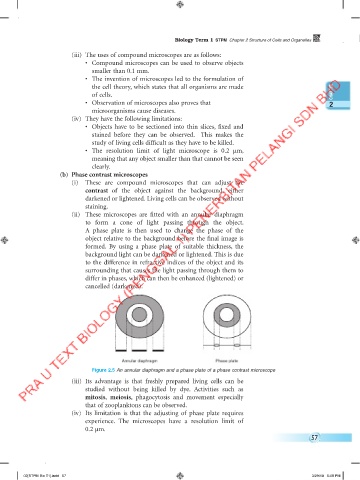
                         (ii)  These microscopes are fitted with an annular diaphragm
                             to form a cone of light passing through the object.
                             A phase plate is then used to change the phase of the
                             object relative to the background before the final image is
                             formed.  By  using  a  phase  plate  of  suitable  thickness,  the
                             background light can be darkened or lightened. This is due
                             to the difference in refractive indices of the object and its
                             surrounding that causes the light passing through them to
                             differ in phases, which can then be enhanced (lightened) or
                             cancelled (darkened).


                                           Annular diaphragm             Phase plate
                               Figure 2.5 An annular diaphragm and a phase plate of a phase contrast microscope
                         (iii)  Its advantage is that freshly prepared living cells can be
                             studied  without  being  killed  by  dye.  Activities  such  as
                             mitosis,  meiosis, phagocytosis and movement especially
                             that of zooplanktons can be observed.
                         (iv)  Its limitation is that the adjusting of phase plate requires
                             experience. The microscopes have a resolution limit of
                             0.2 µm.
                                                                                                        57


         02[STPM Bio T1].indd   57                                                                      3/29/18   5:08 PM

