


Page 42 - PRE-U STPM BIOLOGY TERM 1
P. 42
Biology Term 1  STPM  Chapter 2 Structure of Cells and Organelles

                  4.  The functions of parenchyma are as follows:
                     (a)  It functions as a photosynthetic tissue as in the mesophyll of the
                         leaves or in young stems.
                     (b)  It functions as a storage tissue as in the cortices or the pith of
                         stems and roots. Some fruits and seeds have parenchyma cells as
                         storage tissue.
                     (c)  It functions as  packing tissue around the vascular bundles of                      2
                         stems and leaf stalks.
                     (d)  As epidermis, it protects the cells beneath physically and from
                         desiccation.
                Collenchyma

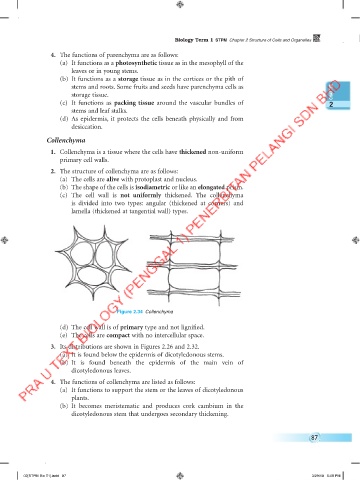
                  1.  Collenchyma is a tissue where the cells have thickened non-uniform
                     primary cell walls.

                  2.  The structure of collenchyma are as follows:
                     (a)  The cells are alive with protoplast and nucleus.
                     (b)  The shape of the cells is isodiametric or like an elongated prism.
                     (c)  The cell wall is  not uniformly thickened. The collenchyma
                         is divided into two types: angular (thickened at corners) and
                         lamella (thickened at tangential wall) types.


                                        Figure 2.34  Collenchyma

                     (d)  The cell wall is of primary type and not lignified.
                     (e)  The cells are compact with no intercellular space.
                  3.  Its distributions are shown in Figures 2.26 and 2.32.
                     (a)  It is found below the epidermis of dicotyledonous stems.
                     (b)  It is found beneath the epidermis of the main vein of
                         dicotyledonous leaves.
                  4.  The functions of collenchyma are listed as follows:
                     (a)  It functions to support the stem or the leaves of dicotyledonous
                         plants.
                     (b)  It becomes  meristematic  and produces cork cambium in  the
                         dicotyledonous stem that undergoes secondary thickening.


                                                                                                        87


         02[STPM Bio T1].indd   87                                                                      3/29/18   5:08 PM

