


Page 43 - PRE-U STPM BIOLOGY TERM 1
P. 43
Biology Term 1  STPM  Chapter 2 Structure of Cells and Organelles

                                        Sclerenchyma
                                          1.  Sclerenchyma is a simple tissue consisting of fibre cells or stone cells
                                            (sclereids), which have thick walls impregnated with lignin.
                                          2.  The structural features are listed as follows:
                                            (a)  When sclerenchyma cells mature, the cells are dead and have no

          2                                     protoplast.
                                            (b)  They have thick secondary walls impregnated with lignin. Lignin
                                                is  a  branched  polymer  which  makes  the  wall  very  hard  and
                                                impervious to water. The walls have many pits.
                                            (c)  Their lumens are very small and empty.
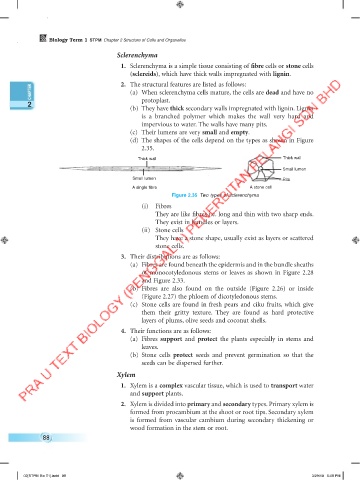
                                            (d)  The shapes of the cells depend on the types as shown in Figure
                                                2.35.
                                               Thick wall                                      Thick wall

                                                                                               Small lumen
                                             Small lumen                                       Pits
                                             A single fibre                         A stone cell
                                                          Figure 2.35  Two types of sclerenchyma
                                                (i)  Fibres
                                                     They are like fibres i.e. long and thin with two sharp ends.
                                                     They exist in bundles or layers.
                                                (ii)  Stone cells
                                                     They have a stone shape, usually exist as layers or scattered
                                                     stone cells.
                                          3.  Their distributions are as follows:
                                            (a)  Fibres are found beneath the epidermis and in the bundle sheaths
                                                of monocotyledonous stems or leaves as shown in Figure 2.28
                                                and Figure 2.33.
                                            (b)  Fibres are also found on the outside (Figure 2.26) or inside
                                                (Figure 2.27) the phloem of dicotyledonous stems.
                                            (c)  Stone cells are found in fresh pears and ciku fruits, which give
                                                them their gritty texture. They are found as hard protective
                                                layers of plums, olive seeds and coconut shells.
                                          4.  Their functions are as follows:
                                            (a)  Fibres  support and  protect the plants especially in stems and
                                                leaves.
                                            (b)  Stone cells  protect seeds and prevent germination so that the
                                                seeds can be dispersed further.

                                        Xylem
                                          1.  Xylem is a complex vascular tissue, which is used to transport water
                                            and support plants.
                                          2.  Xylem is divided into primary and secondary types. Primary xylem is
                                            formed from procambium at the shoot or root tips. Secondary xylem
                                            is formed from vascular cambium during secondary thickening or
                                            wood formation in the stem or root.
               88


         02[STPM Bio T1].indd   88                                                                      3/29/18   5:08 PM

