Page 49 - PRE-U STPM CHEMISTRY TERM 1
P. 49
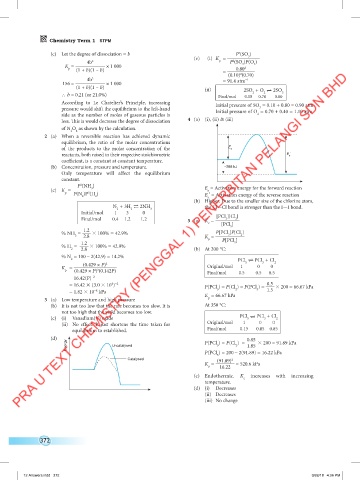
Chemistry Term 1  STPM
                                                                                2
                  (c)  Let the degree of dissociation = b                      P (SO )
                                                                                   3
                                                                 (e)    (i)  K   =
                                                                              2
                              4b 2                                        p  P (SO )P(O )
                       K  =          × 1 000                                     2   2
                        p  (1 + b)(1 – b)                                  =   0.80 2
                                                                                 2
                              4b 2                                           (0.10) (0.70)
                                                                                  –1
                      156 =          × 1 000                               = 91.4 atm
                          (1 + b)(1 – b)                             (ii)         2SO  + O    2SO
                     ∴ b = 0.21 (or 21.0%)                               Final/mol  0.10 2  0.70 2  0.80 3
                     According to Le Chatelier’s Principle, increasing
                     pressure would shift the equilibrium to the left-hand      Initial pressure of SO  = 0.10 + 0.80 = 0.90 atm
                                                                                       2
                     side as the number of moles of gaseous particles is            Initial pressure of O  = 0.70 + 0.40 = 1.10 atm
                                                                                      2
                     less. This is would decrease the degree of dissociation     4  (a)  (i), (ii) & (iii)
                     of N O  as shown by the calculation.
                        2  4
                2  (a)  When a reversible reaction has achieved dynamic

                     equilibrium, the ratio of the molar  concentrations
                     of the products to the molar concentration of the       E a
                     reactants, both raised to their respective stoichiometric                  E ’ a
                     coefficient, is a constant at constant temperature.
                  (b)  Concentration, pressure and temperature.            –288 kJ
                     Only  temperature  will  affect  the  equilibrium
                     constant.
                           P (NH )                                   E  = Activation energy for the forward reaction
                            2
                               3
                  (c)  K  =                                           a
                              3
                       p  P(N )P (H )
                            2    2                                   E ' = Activation energy of the reverse reaction

                                                                      a
                                                                 (b)  Higher. Due to the smaller size of the chlorine atom,
                                             
                                      N  + 3H   2NH                 the Cl—Cl bond is stronger than the I—I bond.
                                        2   2      3
                            Initial/mol   1   3   0                      [PCl ][Cl ]
                            Final/mol   0.4  1.2   1.2          5  (a)  K  =   3  2
                                                                      c   [PCl ]
                             1.2                                             5
                      % NH  =     100% = 42.9%                          P[PCl ]P[Cl ]
                                                                                 2
                                                                             3
                          3  2.8                                     K  =
                                                                      p
                            1.2                                            P[PCl ]
                                                                               5
                     % H  =      100% = 42.9%
                         2  2.8                                  (b)  At 200 °C:
                     % N  = 100 – 2(42.9) = 14.2%
                                                                                   
                         2                                                      PCl   PCl  + Cl
                             (0.429 × P) 2                                        5     3   2
                     K   =                                            Original/mol  1  0   0
                                 3
                       p  (0.429 × P) (0.142P)                        Final/mol    0.5   0.5   0.5
                        = 16.42(P) –2
                                      4 –2
                        = 16.42  (3.0  10 )                        P(PCl ) = P(Cl ) = P(PCl ) =   0.5    200 = 66.67 kPa
                                –8
                        = 1.82  10  kPa                                 3     2      5  1.5
                                                                     K  = 66.67 kPa
                3  (a)  Low temperature and high pressure             p
                  (b)  It is not too low that the rate becomes too slow. It is      At 350 °C:
                     not too high that the yield becomes too low.
                  (c)  (i)  Vanadium(V) oxide                                   PCl     PCl  + Cl 2
                                                                                         3
                                                                                   5
                     (ii)  No  effect.  It  just  shortens  the  time  taken  for   Original/mol  1  0  0
                         equilibrium to established.                  Final/mol    0.15   0.85  0.85
                  (d)                                                              0.85
                       Energy         Uncatalysed                    P(PCl ) = P(Cl )  =   1.85   200 = 91.89 kPa
                                                                               2
                                                                         3
                                                                     P(PCl ) = 200 – 2(91.89) = 16.22 kPa
                                                                         5
                                           Catalysed                     (91.89) 2
                                                                     K  =       = 520.6 kPa
                                                                      p   16.22
                                                                 (c)  Endothermic.  K   increases  with  increasing
                                                                                  c
                                                                     temperature.
                                                                 (d)  (i)  Decreases
                                                                     (ii)  Decreases
                                                                     (iii)  No change
              372
         12 Answers.indd   372                                                                          3/26/18   4:06 PM
   44   45   46   47   48   49   50   51   52   53   54