


Page 37 - ACE YR IGCSE A TOP APPROACH TO CHEM
P. 37
Part 2: Structured Questions (e) The copper electrode dissolves and loses
electrons to form Cu at the anode. [1]
2+
1 (a) Molten lithium chloride [1] The rate of removal of Cu and production of
2+
(b) Concentrated hydrochloric acid [1] Cu is the same. [1]
2+
(c) Copper [1] At the anode, the copper electrode will lose
2+
(d) Water [1] electrons to form Cu since it is not inert.
(e) Concentrated aqueous potassium iodide [1] 4 (a) Left: Anode [1]
(f) Hydrogen [1] Right: Cathode [1]
Metal ion is a cation. It will be attracted to the
(g) Oxygen [1] cathode. So, the key should be placed at the
(h) Sodium chloride [1] cathode.
Penerbitan Pelangi Sdn Bhd. All Rights Reserved.
3+
2 (a) Breakdown of ionic compounds [1] (b) Cathode: Cr + 3e ➞ Cr [1]
3+
in molten or aqueous solution [1] Anode: Cr ➞ Cr + 3e [1]
by the passage of an electric current. [1] (c) To prevent uneven surface [1]
(b) Graphite / Carbon / Platinum [1] (d) Chromium does not stick well on iron. [1]
(c) Clockwise direction [1] (e) The colour of the solution turns purple slowly.
[1]
Ni is attracted to the key. [1]
2+
3+
Chromium will dissolve to form Cr at the
anode. [1]
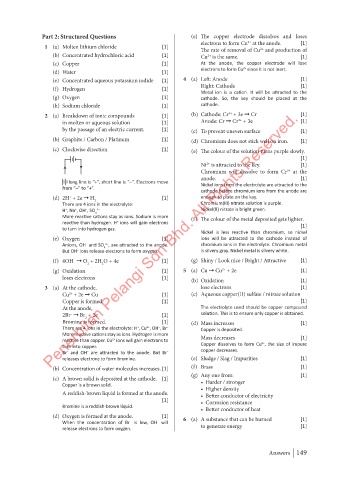
long line is “+”, short line is “–”. Electrons move Nickel ions from the electrolyte are attracted to the
from “–” to “+”.
cathode before chromium ions from the anode are
(d) 2H + 2e ➞ H [1] enough to plate on the key.
+
2
There are 4 ions in the electrolyte: Chromium(III) nitrate solution is purple.
+
–
H , Na , OH , SO 4 2– Nickel(II) nitrate is bright green.
+
More reactive cations stay as ions. Sodium is more (f) The colour of the metal deposited gets lighter.
reactive than hydrogen. H ions will gain electrons
+
to turn into hydrogen gas. [1]
Nickel is less reactive than chromium, so nickel
(e) Oxygen [1] ions will be attracted to the cathode instead of
2–
–
Anions, OH and SO , are attracted to the anode. chromium ions in the electrolyte. Chromium metal
4
But OH ions release electrons to form oxygen. is silvery gray. Nickel metal is silvery white.
–
(f) 4OH ➞ O + 2H O + 4e [1] (g) Shiny / Look nice / Bright / Attractive [1]
–
2
2
2+
(g) Oxidation [1] 5 (a) Cu ➞ Cu + 2e [1]
loses electrons [1] (b) Oxidation [1]
3 (a) At the cathode, lose electrons [1]
Cu + 2e ➞ Cu [1] (c) Aqueous copper(II) sulfate / nitrate solution
2+
Copper is formed. [1] [1]
At the anode, The electrolyte used should be copper compound
2Br ➞ Br + 2e [1] solution. This is to ensure only copper is obtained.
–
2
Bromine is formed. [1] (d) Mass increases [1]
There are 4 ions in the electrolyte: H , Cu , OH , Br – Copper is deposited.
+
2+
–
More reactive cations stay as ions. Hydrogen is more
reactive than copper. Cu ions will gain electrons to Mass decreases 2+ [1]
2+
turn into copper. Copper dissolves to form Cu , the size of impure
–
–
Br and OH are attracted to the anode. But Br – copper decreases.
releases electrons to form bromine. (e) Sludge / Slag / Impurities [1]
(b) Concentration of water molecules increases. [1] (f) Brass [1]
(g) Any one from: [1]
(c) A brown solid is deposited at the cathode. [1]
Copper is a brown solid. • Harder / stronger
• Higher density
A reddish-brown liquid is formed at the anode. • Better conductor of electricity
[1] • Corrosion resistance
Bromine is a reddish-brown liquid. • Better conductor of heat
(d) Oxygen is formed at the anode. [1] 6 (a) A substance that can be burned [1]
–
–
When the concentration of Br is low, OH will
release electrons to form oxygen. to generate energy [1]
Answers 149
Answers.indd 149 3/4/22 3:54 PM

