


Page 52 - ACE YR IGCSE A TOP APPROACH TO CHEM
P. 52
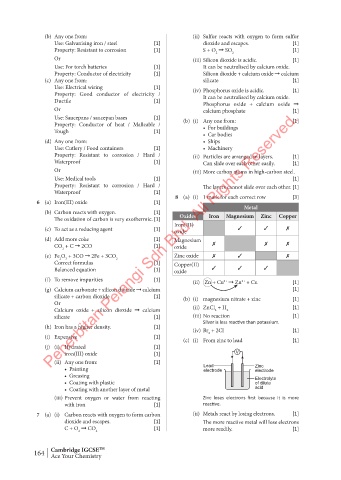
(b)  Any one from:                                  (ii)  Sulfur  reacts  with  oxygen  to  form  sulfur
                         Use: Galvanising iron / steel       [1]              dioxide and escapes.           [1]
                         Property: Resistant to corrosion    [1]              S + O  ➞ SO                    [1]
                                                                                  2     2
                         Or                                               (iii) Silicon dioxide is acidic.   [1]
                         Use: For torch batteries            [1]              It can be neutralised by calcium oxide.
                         Property: Conductor of electricity   [1]             Silicon dioxide + calcium oxide ➞ calcium
                      (c)  Any one from:                                      silicate                       [1]
                         Use: Electrical wiring              [1]          (iv)  Phosphorus oxide is acidic.   [1]
                         Property:  Good  conductor  of  electricity  /             It can be neutralised by calcium oxide.
                         Ductile                             [1]              Phosphorus  oxide  +  calcium  oxide  ➞
                         Or                                                   calcium phosphate              [1]
                        Penerbitan Pelangi Sdn Bhd. All Rights Reserved.
                         Use: Saucepans / saucepan bases     [1]       (b)  (i)  Any one from:               [1]
                         Property:  Conductor  of  heat  /  Malleable  /             •  For buildings
                         Tough                               [1]
                                                                              •  Car bodies
                      (d)  Any one from:                                      •  Ships
                         Use: Cutlery / Food containers      [1]              •  Machinery
                         Property:  Resistant  to  corrosion  /  Hard  /          (ii)  Particles are arranged in layers.   [1]
                         Waterproof                          [1]              Can slide over each other easily.   [1]
                         Or                                               (iii) More carbon atoms in high-carbon steel.
                         Use: Medical tools                  [1]                                             [1]
                         Property:  Resistant  to  corrosion  /  Hard  /             The layers cannot slide over each other. [1]
                         Waterproof                          [1]
                                                                     8  (a)  (i)  1 mark for each correct row   [3]
                    6  (a)  Iron(III) oxide                  [1]
                                                                                            Metal
                      (b)  Carbon reacts with oxygen.        [1]
                         The oxidation of carbon is very exothermic. [1]  Oxides  Iron  Magnesium  Zinc  Copper
                                                                    Iron(III)
                      (c)  To act as a reducing agent        [1]    oxide                 3        3       7
                      (d)  Add more coke                     [1]    Magnesium
                         CO  + C ➞ 2CO                       [1]    oxide        7                  7      7
                            2
                      (e)  Fe O  + 3CO ➞ 2Fe + 3CO 2                Zinc oxide   7        3                7
                           2
                             3
                         Correct formulas                    [1]    Copper(II)
                         Balanced equation                   [1]    oxide        3        3        3
                      (f)  To remove impurities              [1]          (ii)  Zn + Cu  ➞ Zn  + Cu          [1]
                                                                                           2+
                                                                                     2+
                      (g)  Calcium carbonate + silicon dioxide ➞ calcium                                     [1]
                         silicate + carbon dioxide           [1]       (b)  (i)  magnesium nitrate + zinc    [1]
                         Or
                         Calcium  oxide  +  silicon  dioxide  ➞ calcium          (ii)  ZnCl  + H             [1]
                                                                                  2
                                                                                      2
                         silicate                            [1]          (iii) No reaction                  [1]
                                                                              Silver is less reactive than potassium.
                      (h)  Iron has a higher density.        [1]
                                                                          (iv)  Br  + 2Cl                    [1]
                                                                                     –
                      (i)  Expensive                         [1]                2
                                                                       (c)  (i)  From zinc to lead           [1]
                      (j)  (i)  Hydrated                     [1]
                             iron(III) oxide                 [1]                         V
                         (ii)  Any one from:                 [1]
                             •  Painting                                      Lead              Zinc
                                                                              electrode
                                                                                                electrode
                             •  Greasing                                                        Electrolyte
                             •  Coating with plastic                                            of dilute
                             •  Coating with another layer of metal                             acid
                         (iii) Prevent  oxygen  or  water  from  reacting     Zinc  loses  electrons  first  because  it  is  more
                             with iron                       [1]              reactive.
                    7  (a)  (i)  Carbon reacts with oxygen to form carbon          (ii)  Metals react by losing electrons.   [1]
                             dioxide and escapes.            [1]              The more reactive metal will lose electrons
                             C + O  ➞ CO                     [1]              more readily.                  [1]
                                  2
                                        2
                        Cambridge IGCSE  TM
                  164     Ace Your Chemistry


         Answers.indd   164                                                                                         3/4/22   3:54 PM

