


Page 48 - ACE YR IGCSE A TOP APPROACH TO CHEM
P. 48
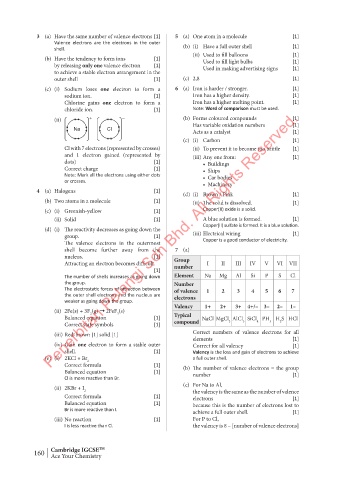
3  (a)  Have the same number of valence electrons [1]    5  (a)  One atom in a molecule   [1]
                         Valence  electrons  are  the  electrons  in  the  outer
                         shell.                                        (b)  (i)  Have a full outer shell     [1]
                                                                          (ii)  Used to fill balloons        [1]
                      (b)  Have the tendency to form ions    [1]              Used to fill light bulbs       [1]
                         by releasing only one valence electron   [1]            Used in making advertising signs   [1]
                         to achieve a stable electron arrangement in the
                         outer shell                         [1]       (c)  2,8                              [1]
                      (c)  (i)  Sodium  loses  one electron to form a     6  (a)  Iron is harder / stronger.   [1]
                             sodium ion.                     [1]          Iron has a higher density.         [1]
                             Chlorine gains  one electron to form a          Iron has a higher melting point.   [1]
                             chloride ion.                   [1]          Note: Word of comparison must be used.

                         (ii)         +          –                     (b)  Forms coloured compounds         [1]
                                                                          Has variable oxidation numbers     [1]
                                Na          Cl
                                                                          Acts as a catalyst                 [1]
                                                                       (c)  (i)  Carbon                      [1]
                             Cl with 7 electrons (represented by crosses)          (ii)  To prevent it to become too brittle   [1]
                             and 1 electron gained (represented by          (iii) Any one from:              [1]
                             dots)                           [1]              •  Buildings
                             Correct charge                  [1]              •  Ships
                             Note: Mark all the electrons using either dots             •  Car bodies
                             or crosses.
                                                                              •  Machinery
                    4  (a)  Halogens                         [1]
                                                                       (d)  (i)  Brown / Pink                [1]
                      (b)  Two atoms in a molecule           [1]          (ii)  The solid is dissolved.      [1]
                      (c)  (i)  Greenish-yellow              [1]              Copper(II) oxide is a solid.
                         (ii)  Solid                         [1]              A blue solution is formed.     [1]
                                                                              Copper(II) sulfate is formed. It is a blue solution.
                      (d)  (i)  The reactivity decreases as going down the
                             group.                          [1]          (iii) Electrical wiring            [1]
                                                                              Copper is a good conductor of electricity.

                        Penerbitan Pelangi Sdn Bhd. All Rights Reserved.
                             The valence electrons in the outermost
                             shell become further away from the      7  (a)
                             nucleus.                        [1]
                             Attracting an electron becomes difficult.   Group  I   II   III  IV    V   VI  VII
                                                                    number
                                                             [1]
                             The number of shells increases as going down   Element  Na  Mg  Al  Si  P   S   Cl
                             the group.                             Number
                             The electrostatic forces of attraction between   of valence   1  2  3  4  5  6  7
                             the outer shell electrons and the nucleus are   electrons
                             weaker as going down the group.
                                                                    Valency    1+   2+   3+   4+/– 3–   2–   1–
                         (ii)  2Fe(s) + 3F (g) ➞ 2FeF (s)
                                                3
                                      2
                             Balanced equation               [1]    Typical   NaCl MgCl AlCl SiCl PH   H S HCl
                             Correct state symbols           [1]    compound           2    3    4   3   2
                         (iii) Red-brown [1] solid [1]                    Correct numbers of valence electrons for all
                                                                          elements                           [1]
                         (iv)  Gain one electron to form a stable outer          Correct for all valency     [1]
                             shell.                          [1]          Valency is the loss and gain of electrons to achieve
                      (e)  (i)  2KCl + Br 2                               a full outer shell.
                             Correct formula                 [1]       (b)  The number of valence electrons = the group
                             Balanced equation               [1]          number                             [1]
                             Cl is more reactive than Br.
                                                                       (c)  For Na to Al,
                         (ii)  2KBr + I 2                                 the valency is the same as the number of valence
                             Correct formula                 [1]          electrons                          [1]
                             Balanced equation               [1]          because this is the number of electrons lost to
                             Br is more reactive than I.                  achieve a full outer shell.        [1]
                         (iii) No reaction                   [1]          For P to Cl,
                             I is less reactive than Cl.                  the valency is 8 – [number of valence electrons]


                        Cambridge IGCSE  TM
                  160     Ace Your Chemistry


         Answers.indd   160                                                                                         3/4/22   3:54 PM

