


Page 49 - ACE YR IGCSE A TOP APPROACH TO CHEM
P. 49
or                                          9  (a)  (i)  Neon                       [1]
                            Valency + valence electrons = 8    [1]               Neon is a noble gas. It is monatomic at room
                            because this is the number of electrons needed       temperature because it is unreactive.
                            to achieve a full outer shell.     [1]           (ii)  Lithium / Beryllium          [1]
                         (d)  (i)  Basic oxide to amphoteric oxide to acidic     All  Group  I  and  II  elements  form  a  metal
                                oxide                          [2]               hydroxide  which  is  alkaline  when  react  with
                                Metal oxide is basic.                            water.
                                Non-metal oxide is acidic.                       2Li + 2H O ➞ 2LiOH + H 2
                                                                                       2
                                Aluminium oxide is amphoteric.               (iii) Nitrogen                     [1]
                            (ii)  Ionic bond                   [1]               78% of the air is nitrogen. 21% is oxygen.
                                to covalent bond               [1]           (iv)  Oxygen                       [1]
                        Penerbitan Pelangi Sdn Bhd. All Rights Reserved.
                                Metals form ionic compounds with chlorine.       Iron reacts with oxygen to form iron(II) oxide. It
                                Chlorine forms covalent bonds with non-metals.   is known as rusting.
                         (e)  Macromolecule                    [1]           (v)  Lithium                       [1]
                            Tetrahedral                        [1]               Lithium is a soft metal which is very reactive.
                            One silicon atom is bonded to four chlorine          It must be stored in oil  to stop  lithium from
                            atoms.                             [1]               reacting with oxygen in the air.
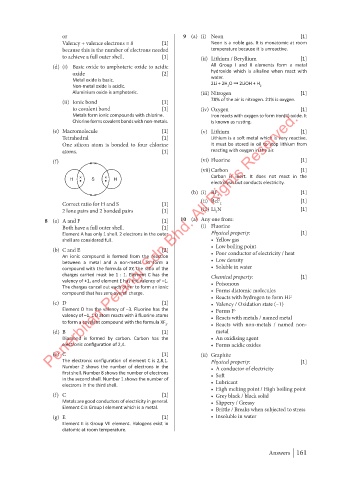
                         (f)                                                 (vi) Fluorine                      [1]
                                                                             (vii) Carbon                       [1]
                                                                                 Carbon  is  inert.  It  does  not  react  in  the
                               H       S      H
                                                                                 electrolysis but conducts electricity.
                                                                          (b)  (i)  BF                          [1]
                                                                                   3
                                                                             (ii)  BeF                          [1]
                            Correct ratio for H and S          [1]                  2
                            2 lone pairs and 2 bonded pairs    [1]           (iii) Li N                         [1]
                                                                                  3
                       8  (a)  A and F                         [1]      10  (a)  Any one from:
                            Both have a full outer shell.      [1]           (i)  Fluorine
                            Element A has only 1 shell. 2 electrons in the outer        Physical property:      [1]
                            shell are considered full.                           •   Yellow gas
                                                                                 •   Low boiling point
                         (b)  C and E                          [2]               •   Poor conductor of electricity / heat
                            An  ionic  compound  is  formed  from  the  reaction
                            between  a  metal  and  a  non-metal.  To  form  a             •   Low density
                            compound with the formula of XY, the ratio of the             •   Soluble in water
                            charges carried must be 1 : 1. Element C has the        Chemical property:          [1]
                            valency of +1, and element E has the valency of –1.             •   Poisonous
                            The charges cancel out each other to form an ionic
                            compound that has zero overall charge.               •   Forms diatomic molecules
                                                                                 •   Reacts with hydrogen to form HF
                         (c)  D                                [1]               •   Valency / Oxidation state (–1)
                            Element D has the valency of –3. Fluorine has the             •   Forms F –
                            valency of –1. 1 D atom reacts with 3 fluorine atoms             •   Reacts with metals / named metal
                            to form a covalent compound with the formula XF .
                                                                 3               •   Reacts  with  non-metals  /  named  non-
                         (d)  B                                [1]                metal
                            Diamond  is  formed  by  carbon.  Carbon  has  the             •   An oxidising agent
                            electronic configuration of 2,4.                     •   Forms acidic oxides
                         (e)  C                                [1]           (ii)  Graphite
                            The electronic configuration of element C is 2,8,1.        Physical property:       [1]
                            Number  2  shows  the  number  of  electrons  in  the             •   A conductor of electricity
                            first shell. Number 8 shows the number of electrons             •   Soft
                            in the second shell. Number 1 shows the number of
                            electrons in the third shell.                        •   Lubricant
                                                                                 •   High melting point / High boiling point
                         (f)  C                                [1]               •   Grey black / black solid
                            Metals are good conductors of electricity in general.             •   Slippery / Greasy
                            Element C is Group I element which is a metal.            •   Brittle / Breaks when subjected to stress
                         (g)  E                                [1]               •   Insoluble in water
                            Element E is Group VII element. Halogens exist in
                            diatomic at room temperature.


                                                                                                     Answers    161


         Answers.indd   161                                                                                         3/4/22   3:54 PM

