


Page 47 - ACE YR IGCSE A TOP APPROACH TO CHEM
P. 47
3  B                                             7  C
                                                                          Carbon forms a giant covalent structure which has a high
                                                                          melting point.
                                                                          Chromium is a transition element. It has a high melting
                         The  atomic  radius  increases  as  going  down  Group  I   point.
                         because the number of shells / orbits increases.     Caesium is a metal. As going down the group, the melting
                         As  the  atomic  radius  increases  down  the  group,  the   point decreases. Caesium has a low melting point.
                         melting point decreases.
                         The attraction between the nucleus and electrons in the     8  D
                         outer shell is weaker as the distance increases. The weak      The roman number represents the oxidation state of an
                         attraction  also  causes  them  to  become  more  reactive   element.  It  is  important  because  some  elements  have
                         when down the group.                             variable oxidation states. Iron shows two oxidation states,
                         2Na + 2H O ➞ 2NaOH + H 2                         that is +2 and +3. So, (II) and (III) are used in the naming.
                        Penerbitan Pelangi Sdn Bhd. All Rights Reserved.
                               2
                         NaOH is alkaline.                              9  B
                       4  C                                               W is sodium. Sodium is very reactive. Sodium reacts with
                         The element located above iodine in the Periodic Table   cold water.
                         is  bromine.  Bromine  is  a  red-brown  liquid  at  room      X is neon. Neon is unreactive.
                         temperature. Bromine is more reactive than iodine.     Y is manganese. Manganese is a transition metal. It has
                                                                          variable oxidation states.
                       5  B                                               Z is silicon. Silicon forms macromolecules with oxygen.
                         The proton number of helium is 2. It is unreactive.
                         The  proton  number  of  beryllium  is  4.  Beryllium  is  a     10  A
                         metal. It can react with oxygen to form beryllium oxide.     Hydrogen  is  flammable.  It  can  trigger  an  explosion
                         The proton number of carbon is 6. Carbon reacts with   when it gets in touch with fire or sparks. Helium is an
                         oxygen to form carbon dioxide.                   unreactive gas. So, it is safe.
                         The  proton  number  of  oxygen  is  8.  Oxygen  can  form
                         diatomic  molecules  with  each  other  but  cannot  form   Part 2: Structured Questions
                         oxides.                                        1  (a)  Increasing proton number        [1]
                         The proton number of neon is 10. It is unreactive.
                                                                          (b)  React in the similar way         [1]
                       6  B
                         Rubidium is Group I element. It reacts with bromine to          Have the same number of electrons in the
                         form an  ionic  compound.  Rb  loses  1  electron  to  form   outer shell / Have the same number of valence
                                                    –
                           +
                         Rb .  Br  gains  1  electron  to  form  Br .  So,  the  chemical   electrons           [1]
                         formula for rubidium bromide is RbBr. Since rubidium is
                         Group I element, it cannot form a coloured compound.      (c)  The number of shells    [1]
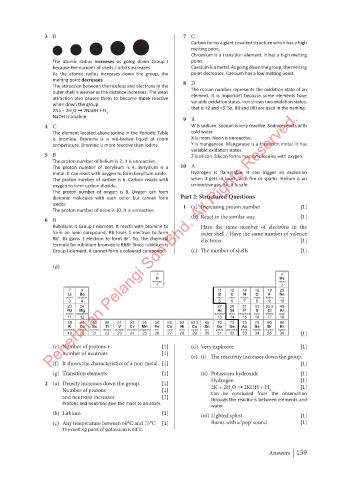
                         (d)
                                                             1                                           4
                                                             H                                           He
                                                            hydrogen                                     helium
                                                             1                                           2
                              7    9                                               11  12   14  16   19  20
                              Li  Be                                               B    C   N   O    F   Ne
                              lithium  beryllium                                   boron  carbon  nitrogen  oxygen  fluorine  neon
                              3    4                                               5    6   7    8   9   10
                              23  24                                               27  28   31  32  35.5  40
                              Na  Mg                                               Al  Si   P   S    Cl  Ar
                              sodium  magnesium                                   aluminium  silicon  phosphorus  sulfur  chlorine  argon
                              11  12                                               13  14   15  16   17  18
                              39  40   45  48   51  52  55   56  59   59  63.5  65  70  73  75  79   80  84
                              K   Ca   Sc  Ti   V   Cr  Mn   Fe  Co   Ni  Cu  Zn   Ga  Ge   As  Se   Br  Kr
                             potassium  calcium  scandium  titanium  vanadium  chromium manganese  iron  cobalt  nickel  copper  zinc  gallium  germanium  arsenic  selenium  bromine  krypton
                              19  20   21  22   23  24  25   26  27   28  29   30  31  32   33  34   35  36     [1]
                         (e)  Number of protons +              [1]        (d)  Very explosive                   [1]
                            number of neutrons                 [1]
                                                                          (e)  (i)  The reactivity increases down the group.
                         (f)  It shows the characteristics of a non-metal.  [1]                                 [1]

                         (g)  Transition elements              [1]           (ii)  Potassium hydroxide          [1]
                                                                                 Hydrogen                       [1]
                       2  (a)  Density increases down the group.   [1]            2K + 2H O ➞ 2KOH + H          [1]
                            Number of protons                  [1]               Can  be  concluded  from  the  observation
                                                                                        2
                                                                                                     2
                            and neutrons increases             [1]               through the reactions between elements and
                            Protons and neutrons give the mass to an atom.       water.
                         (b)  Lithium                          [1]           (iii) Lighted splint               [1]

                         (c)  Any temperature between 60°C and 75°C  [1]            Burns with a ‘pop’ sound    [1]
                            The melting point of potassium is 63°C.


                                                                                                     Answers    159


         Answers.indd   159                                                                                         3/4/22   3:54 PM

