


Page 29 - Focus SPM KSSM Tg 4.5 - Add Maths
P. 29
Additional Mathematics SPM Chapter 2 Quadratic Functions
SPM Practice 2
SPM Practice
PAPER 1
1. Given that the quadratic equation 2x + px – 18 = 0, 12. Given that the quadratic function f(x) = 14x – 2x .
2
2
where p is a constant, find the value of p if Find
(a) one of the roots of the equation is 2, (a) the coordinates of the vertex of the quadratic
(b) the sum of the equation roots is –1. function,
(b) the range of values of x when f(x) is positive.
2. Given that α and b are the roots of the quadratic
equation 2x – 6x – 3 = 0. Form a quadratic equation 13. f(x)
2
with roots 2α and 2b.
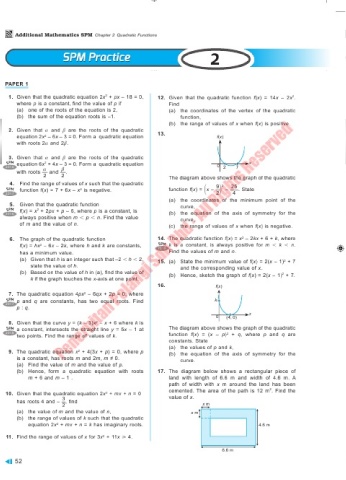
Form 4
3. Given that α and b are the roots of the quadratic
SPM equation 6x + 4x – 3 = 0. Form a quadratic equation x
2
2016 0 2 7
with roots α and b .
2 2 The diagram above shows the graph of the quadratic
4. Find the range of values of x such that the quadratic 9 2 25
2
SPM function f(x) = 7 + 6x – x is negative. function f(x) = x – – . State
2017 2 4
(a) the coordinates of the minimum point of the
5. Given that the quadratic function curve,
SPM f(x) = x + 2px + p – 6, where p is a constant, is
2
2016 (b) the equation of the axis of symmetry for the
always positive when m p n. Find the value curve,
of m and the value of n. (c) the range of values of x when f(x) is negative.
6. The graph of the quadratic function 14. The quadratic function f(x) = x – 2kx + 6 + k, where
2
SPM
f(x) = hx – 6x – 2k, where h and k are constants, 2018 k is a constant, is always positive for m k n.
2
has a minimum value. Find the values of m and n.
(a) Given that h is an integer such that –2 h 2, 15. (a) State the minimum value of f(x) = 2(x – 1) + 7
2
state the value of h. and the corresponding value of x.
(b) Based on the value of h in (a), find the value of (b) Hence, sketch the graph of f(x) = 2(x – 1) + 7.
2
k if the graph touches the x-axis at one point.
16. f(x)
7. The quadratic equation 4px – 6qx + 2p = 0, where
2
SPM p and q are constants, has two equal roots. Find k
2017
p : q.
x
0 (4, 0)
2
8. Given that the curve y = (k – 3)x – x + 6 where k is
SPM a constant, intersects the straight line y = 5x – 1 at The diagram above shows the graph of the quadratic
2018 function f(x) = (x – p) + q, where p and q are
2
two points. Find the range of values of k.
constants. State
(a) the values of p and k,
9. The quadratic equation x + 4(3x + p) = 0, where p (b) the equation of the axis of symmetry for the
2
is a constant, has roots m and 2m, m ≠ 0. curve.
(a) Find the value of m and the value of p.
(b) Hence, form a quadratic equation with roots 17. The diagram below shows a rectangular piece of
m + 6 and m – 1 . land with length of 6.6 m and width of 4.6 m. A
path of width with x m around the land has been
cemented. The area of the path is 12 m . Find the
2
10. Given that the quadratic equation 2x + mx + n = 0 value of x.
2
3
has roots 4 and – , find
2 x m
(a) the value of m and the value of n, x m
(b) the range of values of k such that the quadratic
equation 2x + mx + n = k has imaginary roots. 4.6 m
2
11. Find the range of values of x for 3x + 11x > 4.
2
6.6 m
52

