


Page 27 - Focus SPM KSSM Tg 4.5 - Add Maths
P. 27
Additional Mathematics SPM Chapter 2 Quadratic Functions
9. The graph of the quadratic function f(x) = px – 2x + p (a) Express f(x) in the form of –(x + m) + n, where
2
2
touches the x-axis at only one point. Find the m and n are constants.
possible values of p. (b) State the equation of the axis of symmetry for
the curve.
10. The graph of the quadratic function f(x) = 2hx – 6hx + 9
2
touches the x-axis at only one point. Find the value 19. Given that the minimum value of f(x) = x – 5x + p
2
of h. 9
is – . Find the value of p.
11. The line y = 1 – 5x intersects the curve y = t – x – 2x 2 4
at two different points. Find the range of values of t. 20. Given that the maximum value of f(x) = k – 6x – x
2
is 3. Find the value of k.
12. Given that f(x) = 2(x – 4) – 8 = a(x – p)(x – q) for
2
all values of x. Find the values of a, p and q where 21. The quadratic function, f(x) = 1 – 2p + 3px – x
2
2
p q. has a maximum value of (q – p) where p and q are
2
13. Express each of the following the vertex form of constants. By using completing the squares method,
quadratic functions into general form and intercept show that q = p + 2 .
form. 2
Form 4
(a) f(x) = (x + 2) – 9 22. The quadratic function f(x) = x + 4px + 5p – 1 has
2
2
2
2
(b) f(x) = 2 x – 9 2 – 1 a minimum value of (q + 2p – 2), where p and q are
constants. By using completing the squares method,
8
4
(c) f(x) = 4 – (2x – 1) 2 express p in terms of q.
14. Find the vertex of the quadratic function 23. The diagram below shows the graph of the function
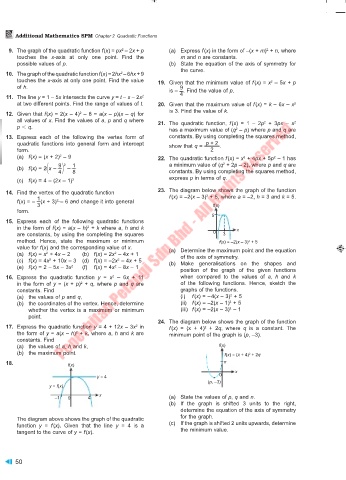
f(x) = –2(x – 3) + 5, where a = –2, h = 3 and k = 5.
2
1
f(x) = – (x + 3) – 6 and change it into general
2
3 f(x)
form.
5
15. Express each of the following quadratic functions
in the form of f(x) = a(x – h) + k where a, h and k x
2
are constants, by using the completing the squares 0 3
method. Hence, state the maximum or minimum f(x) = –2(x – 3) + 5
2
value for f(x) and the corresponding value of x. (a) Determine the maximum point and the equation
(a) f(x) = x + 4x – 2 (b) f(x) = 2x – 4x + 1 of the axis of symmetry.
2
2
(c) f(x) = 4x + 10x – 3 (d) f(x) = –2x – 4x + 5 (b) Make generalisations on the shapes and
2
2
2
2
(e) f(x) = 2 – 5x – 3x (f) f(x) = 4x – 8x – 1
position of the graph of the given functions
2
16. Express the quadratic function y = x – 6x + 11 when compared to the values of a, h and k
in the form of y = (x + p) + q, where p and q are of the following functions. Hence, sketch the
2
constants. Find graphs of the functions.
2
(a) the values of p and q, (i) f(x) = – 4(x – 3) + 5
(b) the coordinates of the vertex. Hence, determine (ii) f(x) = –2(x – 1) + 5
2
2
whether the vertex is a maximum or minimum (iii) f(x) = –2(x – 3) – 1
point.
24. The diagram below shows the graph of the function
17. Express the quadratic function y = 4 + 12x – 3x in f(x) = (x + 4) + 2q, where q is a constant. The
2
2
the form of y = a(x – h) + k, where a, h and k are minimum point of the graph is (p, –3).
2
constants. Find
(a) the values of a, h and k, f(x)
(b) the maximum point. f(x) = (x + 4) + 2q
2
18. f(x) n
x
y = 4 0
(p, –3)
y = f(x)
x
–1 0 4 (a) State the values of p, q and n.
(b) If the graph is shifted 3 units to the right,
determine the equation of the axis of symmetry
The diagram above shows the graph of the quadratic for the graph.
function y = f(x). Given that the line y = 4 is a (c) If the graph is shifted 2 units upwards, determine
tangent to the curve of y = f(x). the minimum value.
50

