


Page 21 - Focus SPM KSSM F4 2020 - Chemistry
P. 21
Chemistry Form 4  Chapter 3 The Mole Concept, Chemical Formula and Equation
                                                         SPM    Highlights
        EXAMPLE 3.22
         Calculate the percentage by mass of carbon in   What is the mass of oxygen in 132 g of carbon
         octane, C H  [Relative atomic mass: H, 1; C, 12]  dioxide, CO ?
                                                                 2
                   18
                                                        [Relative atomic mass: C,12; O, 16]
                 8
         Solution                                       A  16 g            C  48 g
         The mass of 1 mole of octane, C H 18           B  32 g            D  64 g
                                     8
         = 8(12) + 18(1)                                Examiner’s tip
         = 114 g                                        Number of moles of CO
         Based on its formula, 1 mole of C H has 8           Mass       132 2  132
                                        18
                                      8
         moles of carbon atoms.                         =  Molar mass   =   12+2(16)  =   44   = 3 mol
         The  mass of carbon in 1 mole of  C H = 8 × 12 = 96 g   Based on the formula, 1 mole of CO  contains 2
                                    8
                                      18
         So, the percentage by mass of carbon           moles of O atoms.           2
         =  Mass of carbon in 1 mole of C H 14  × 100%  So, 3 mol of CO  contains 3 × 2, which is 6 moles of
                                                                     2
                                      6
                                                        O atoms.
                Mass of 1 mole of C H                   Mass of oxygen  = number of moles × molar mass   Chapter
             96                  6  14
         =    114  × 100%                                            = 6 × 16
                                                                     = 96 g
         =  84.21%                                      Answer: C                                     3
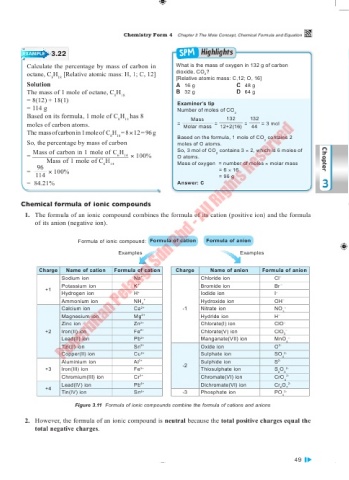
        Chemical formula of ionic compounds
          1.  The formula of an ionic compound combines the formula of its cation (positive ion) and the formula
            of its anion (negative ion).

                         Formula of ionic compound:  Formula of cation     Formula of anion

                                      Examples                              Examples

             Charge   Name of cation  Formula of cation  Charge    Name of anion   Formula of anion
                    Sodium ion             Na +                 Chloride ion           Cl –
                    Potassium ion          K +                  Bromide ion            Br  –
               +1
                    Hydrogen ion           H +                  Iodide ion             I –
                    Ammonium ion           NH 4 +               Hydroxide ion          OH –
                    Calcium ion            Ca 2+          -1    Nitrate ion            NO  –
                                                                                         3
                    Magnesium ion          Mg 2+                Hydride ion            H –
                    Zinc ion               Zn 2+                Chlorate(I) ion        ClO –
               +2   Iron(II) ion           Fe 2+                Chlorate(V) ion        ClO 3 –
                    Lead(II) ion           Pb 2+                Manganate(VII) ion     MnO 4 –
                    Tin(II) ion            Sn 2+                Oxide ion              O
                                                                                        2-
                    Copper(II) ion         Cu 2+                Sulphate ion           SO
                                                                                          2-
                                                                                         4
                    Aluminium ion          Al 3+                Sulphide ion           S
                                                                                        2-
               +3   Iron(III) ion          Fe 3+          -2    Thiosulphate ion       S O
                                                                                          2-
                                                                                        2  3
                    Chromium(III) ion      Cr 3+                Chromate(VI) ion       CrO
                                                                                          2-
                                                                                          4
                    Lead(IV) ion           Pb 4+                Dichromate(VI) ion     Cr O
                                                                                           2-
               +4                            4+                                          2  3- 7
                    Tin(IV) ion            Sn             -3    Phosphate ion          PO
                                                                                         4
                        Figure 3.11  Formula of ionic compounds combine the formula of cations and anions
          2.  However, the formula of an ionic compound is neutral because the total positive charges equal the
            total negative charges.
                                                                                             49


 03 SPM CHEMISTRY F4.indd   49                                                               27/02/2020   11:23 AM

