


Page 22 - Ranger SPM 2022 Chemistry
P. 22
Chemistry SPM  Chapter 2  Carbon Compound
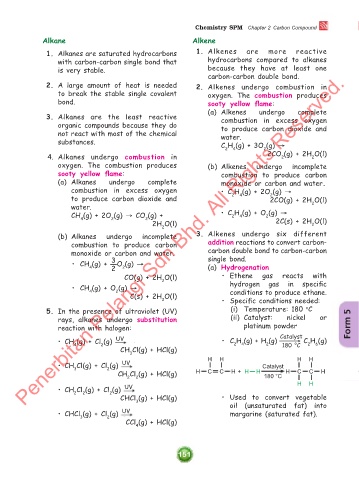
                  Alkane                                   Alkene
                   1.  Alkanes are saturated hydrocarbons    1.  Alkenes are more reactive
                      with carbon-carbon single bond that      hydrocarbons  compared  to  alkanes
                      is very stable.                          because they have at least one
                                                                     2Rights Reserved.
                                                               carbon-carbon  double bond.
                    2.  A large  amount of heat is needed     2.  Alkenes undergo combustion in
                      to break the stable single covalent      oxygen. The  combustion produces
                      bond.                                    sooty  yellow  flame:
                                                               (a)  Alkenes  undergo   complete
                    3.  Alkanes are the least reactive            combustion in excess  oxygen
                      organic  compounds  because they do         to  produce carbon dioxide  and
                      not react with most of the chemical         water.
                      substances.                                 C H (g) +  3O (g) →
                                                                              2
                                                                      4
                                                                    2
                    4.  Alkanes  undergo  combustion in                        2CO (g) +  2H O(l)
                                                                                           2
                                                                                   2
                      oxygen. The combustion produces          (b) Alkenes  undergo   incomplete
                      sooty  yellow  flame:                       combustion to produce carbon
                      (a)  Alkanes  undergo   complete            monoxide  or carbon  and water.
             Penerbitan Pelangi Sdn Bhd. All
                         combustion in excess  oxygen             •  C H (g) +  2O (g) →
                         to  produce carbon dioxide  and               4        2 2CO(g)  +  2H O(l)
                         water.                                                            2
                         CH (g) +  2O (g) → CO (g) +              •  C H (g) +  O (g) →
                                                                     2
                                                                       4
                                                                               2
                            4
                                    2
                                              2
                                                2H O(l)                          2C(s) +  2H O(l)
                                                                                           2
                                                  2
                      (b)  Alkanes  undergo  incomplete     3.  Alkenes undergo  six different
                         combustion to produce carbon          addition reactions to convert carbon-
                         monoxide  or  carbon  and  water.     carbon double bond to carbon-carbon
                          •  CH (g) +   3 O (g) →              single bond.
                                                               (a)  Hydrogenation
                                    2
                              4
                                       2
                                        CO(g) +  2H O(l)           •  Ethene   gas   reacts   with
                                                  2
                          •  CH (g) +  O (g) →                       hydrogen  gas  in  specific
                                                                     conditions to produce ethane.
                              4
                                      2
                                          C(s) +  2H O(l)          •  Specific conditions  needed:
                                                  2
                                                                                          o
                   5.  In  the presence of ultraviolet  (UV)         (i)  Temperature: 180  C
                      rays, alkanes undergo  substitution            (ii)  Catalyst:  nickel  or
                      reaction  with halogen:                            platinum powder              Form 5
                                                                                  Catalyst
                      •  CH (g) +  Cl (g)   UV                     •  C H (g) + H (g) ⎯⎯→ C H (g)
                                                                                          2
                                                                               2
                                                                                            6
                                                                                   180 °C
                                                                      2
                                                                        4
                          4
                                  2
                                       CH Cl(g) + HCl(g)
                                         3
                                                               H  H                    H  H
                      •  CH Cl(g) + Cl (g)   UV                               Catalyst
                                   2
                          3
                                      CH Cl (g) +  HCl(g)  H   C  C  H  +  H  H  180 °C  H  C  C  H
                                         2
                                           2
                      •  CH Cl (g) +  Cl (g)   UV                                      H  H
                          2  2      2
                                       CHCl (g) +  HCl(g)          •  Used  to  convert  vegetable
                                           3
                                                                     oil (unsaturated fat) into
                      •  CHCl (g) +  Cl (g)   UV                     margarine  (saturated  fat).
                            3
                                   2
                                        CCl (g) +  HCl(g)
                                           4
                                                       151
         02.5 RANGER SPM CHEMISTRY 2P.indd   151                                            29/03/2022   2:28 PM

