


Page 91 - DnD 5e - Xanathar's Guide to Everything
P. 91
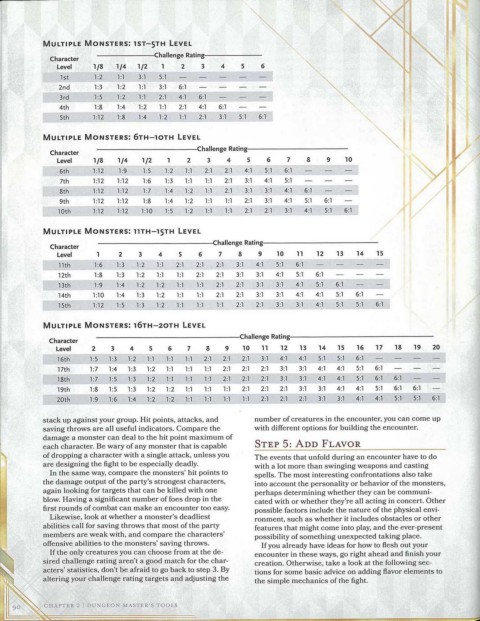
MULTIPLE  MONSTERS:  lST-STH  LEVEL
                          ---------...hallenge Rating·-------
              Character
                Level    1/8   1  /4   1/2   1   2   3   4     5    6
                1st      1:2   1  :1   3:1   5:1
                2nd      1:3   1:2   1  :1   3:1   6:1
                3rd      1:5   1:2   1  :1   2:1   4:1   6:1
                4th      1:8   1:4   1:2   1:1   2:1   4:1   6:1
                5th      1  :12   1:8   1:4   1:2   1:1   2:1   3:1   5:1   6:1


            MULTIPLE  MONSTERS:  6TH-10TH  LEVEL
                          ------------Challenge  Rating·------------
              Character
                Level    1/8   1/4   1/2    1    2    3    4    5    6    7    8    9    10
                6th      1  :12   1:9   1:5   1:2   1  :1   2:1   2:1   4:1   5:1   6:1
                7th      1:12   1:12   1:6   1:3   l :1   1:1   2:1   3:1   4:1   5:1
                8th      1:12   1:12   1:7   1:4   1:2   1  :1   2:1   3:1   3:1   4:1   6:1
                9th      1  :12   1:12   1:8   1:4   1:2   1:1   1:1   2:1   3:1   4:1   5:1   6:1
                10th     1  :12   1:12   1:10   1:5   1:2   1  :1   1  :1   2:1   2:1   3:1   4:1   5:1   6:1

            MULTIPLE  MONSTERS:  llTH-lSTH  LEVEL
                          --------------\.hallenge Rating•-------------
              Character
                Level     1    2    3    4     5    6    7    8    9    10   11   12   13   14   15
                11th     1:6   1:3   1:2   1:1   2:1   2:1   2:1   3:1   4:1   5:1   6:1
                12th     1:8   1:3   1:2   1:1   1:1   2:1   2:1   3:1   3:1   4:1   5:1   6:1
                13th     1:9   1:4   1:2   1:2   1:1   1  :1   2:1   2:1   3:1   3:1   4:1   5:1   6:1
                14th     1:10   1:4   1:3   1:2   1:1   1  :1   2:1   2:1   3:1   3:1   4:1   4:1   5:1   6:1
                15th     1:12   1:5   1:3   1:2   1:1   1  :1   1  :1   2:1   2:1   3:1   3:1   4:1   5:1   5:1   6:1


            MULTIPLE  MONSTERS:  16TH-20TH  LEVEL
                         - ----------------Challenge Rating· -----------------
              Character
               Level    2    3    4    5    6    7    8   9    10   11   12   13   14   15   16   17   18   19   20
                16th    1:5   1:3   1:2   1:1   1:1   1:1   2:1   2:1   2:1   3:1   4:1   4:1   5:1   5:1   6:1
                17th    1:7   1:4   1:3   1:2   1:1   1:1   1  :1   2:1   2:1   2:1   3:1   3:1   4:1   4:1   5:1   6:1
                18th    1:7   1:5   1:3   1:2   1:1   1:1   1  :1   2:1   2:1   2:1   3:1   3:1   4:1   4:1   5:1   6:1   6:1
                19th    1:8   1:5   1:3   1:2   1:2   1:1   l :1   1:1   2:1   2:1   2:1   3:1   3:1   4:1   4:1   5:1   6:1   6:1
                20th    1:9   1  :6   1  :4   1:2   1:2   1:1   1  :1   1:1   1:1   2:1   2:1   2:1   3:1   3:1   4:1   4:1   5:1   5:1   6:1

            stack up against your group. Hit points, attacks, and   number of  creatures in the encounter, you can come up
            saving throws are all usefuJ indicators. Compare the   with different options for building the e ncounter.
            damage a monster can deal to the hit point maximum of
            each character. Be wary of  any monster that is capable   STEP 5: Ann FLAVOR
            of dropping a character with a single attack, unless you   The events that unfold during an encounter have to do
            are designing the fight to be especially deadly.      with a lot more than swinging weapons a nd casting
              In the same way, compare the monsters' hit points to   spells. The most interesting confrontations also take
            the damage output of  the party's strongest characters,   into account the personality or behavior of the monsters,
            again looking for targets that can be killed with one   perhaps determining whether they can be communi-
            blow. Having a significant number of foes drop in the   cated with or whether they're all acting in concert. Other
            first rounds of  combat can make an encounter too easy.   possible factors include the nature of the physical envi-
              Likewise, look at whether a monster's deadliest     ronment, such as whether it includes obstacles or other
            abilities call for saving throws that most of the party   features that might come into play, and the ever-present
            members are weak with, and compare the characters'    possibility of  something unexpected taking place.
            offensive abilities to the monsters' saving throws.     If  you al  ready have ideas for how to flesh out your
              If  the only creatures you can choose from at the de-  encounter in these ways, go right a head and finish your
            sired challenge rating aren't a good match for the char-  creation. Otherwise, take a look at the following sec-
            acters' statistics, don't be afraid to go back to step 3. By   tions for some basic advice on adding flavor elements to
            altering your challenge rating targets and adjusting the   the simple mechanics of the fight.


            CHAPTER 2   DUNGEON  MASTER'S TOOLS

