


Page 105 - The Design Thinking Playbook
P. 105
EXPERT TIP

                  Working with concept maps, mind maps,
                  systems maps, or giga maps


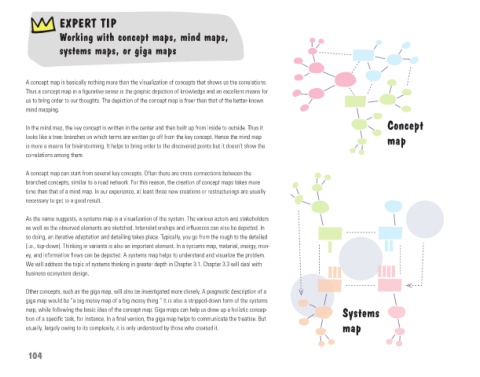
        A concept map is basically nothing more than the visualization of concepts that shows us the correlations.
        Thus a concept map in a figurative sense is the graphic depiction of knowledge and an excellent means for
        us to bring order to our thoughts. The depiction of the concept map is freer than that of the better-known
        mind mapping.

        In the mind map, the key concept is written in the center and then built up from inside to outside. Thus it   Concept
        looks like a tree: branches on which terms are written go off from the key concept. Hence the mind map   map
        is more a means for brainstorming. It helps to bring order to the discovered points but it doesn’t show the
        correlations among them.

        A concept map can start from several key concepts. Often there are cross-connections between the
        branched concepts, similar to a road network. For this reason, the creation of concept maps takes more
        time than that of a mind map. In our experience, at least three new creations or restructurings are usually
        necessary to get to a good result.

        As the name suggests, a systems map is a visualization of the system. The various actors and stakeholders
        as well as the observed elements are sketched. Interrelationships and influences can also be depicted. In
        so doing, an iterative adaptation and detailing takes place. Typically, you go from the rough to the detailed
        (i.e., top-down). Thinking in variants is also an important element. In a systems map, material, energy, mon-
        ey, and information flows can be depicted. A systems map helps to understand and visualize the problem.
        We will address the topic of systems thinking in greater depth in Chapter 3.1. Chapter 3.3 will deal with
        business ecosystem design.

        Other concepts, such as the giga map, will also be investigated more closely. A pragmatic description of a
        giga map would be “a big messy map of a big messy thing.” It is also a stripped-down form of the systems
        map, while following the basic idea of the concept map. Giga maps can help us draw up a holistic concep-  Systems
        tion of a specific task, for instance. In a final version, the giga map helps to communicate the treatise. But
        usually, largely owing to its complexity, it is only understood by those who created it.   map


         104

