


Page 109 - The Design Thinking Playbook
P. 109
1.9  How to create a                                                           Define

                good prototype                                 Understand  Observe     point of   Ideate    Prototype    Test
                                                                                        view


        Prototyping is an important element of design thinking. It encourages   How does our first prototype come into being?
        us to test functions and solutions in reality, in conjunction with the
        desire to learn from users how to improve an offer on an ongoing   In general, ideas are based on many different assumptions. The task is to question these assumptions and
        basis. For this to succeed, all those involved in the process must   confirm them in the real world by testing, or to discard them—that is, disprove them with a counterexam-
        keep an open mind so an idea can be changed or discarded. What   ple on the basis of observations and an experiment. During the prototyping process, prototypes are further
        is crucial here is the willingness to make radical changes. With a   developed and tested in a number of iterations until a usable offer emerges. Ideally, we begin with enough
        prototype, an idea is brought into a form that allows potential users   insights from trend and market research and a solid understanding of the needs and challenges of our
        to experience and evaluate it. At the outset, the prototype must be   potential customers or users.
        only good enough to make the relevant basic features of a future offer
        comprehensible to a target audience. Prototyping makes it possible
        to obtain quick and inexpensive targeted feedback from potential
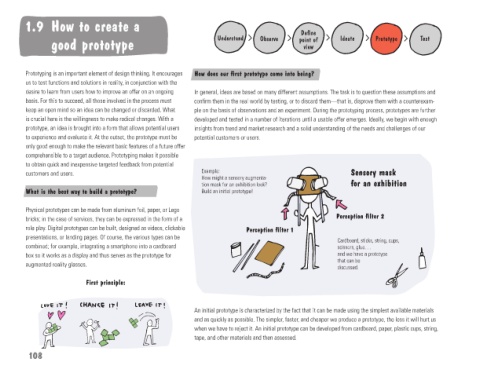
        customers and users.                               Example:                                  Sensory mask
                                                           How might a sensory augmenta-
                                                           tion mask for an exhibition look?         for an exhibition
        What is the best way to build a prototype?         Build an initial prototype!

        Physical prototypes can be made from aluminum foil, paper, or Lego
        bricks; in the case of services, they can be expressed in the form of a                  Perception filter 2
        role play. Digital prototypes can be built, designed as videos, clickable   Perception filter 1
        presentations, or landing pages. Of course, the various types can be                     Cardboard, sticks, string, cups,
        combined; for example, integrating a smartphone into a cardboard                         scissors, glue. . .
        box so it works as a display and thus serves as the prototype for                        and we have a prototype
        augmented reality glasses.                                                               that can be
                                                                                                 discussed.

                          First principle:


                                                         An initial prototype is characterized by the fact that it can be made using the simplest available materials
                                                         and as quickly as possible. The simpler, faster, and cheaper we produce a prototype, the less it will hurt us
                                                         when we have to reject it. An initial prototype can be developed from cardboard, paper, plastic cups, string,
                                                         tape, and other materials and then assessed.
         108

