


Page 110 - The Design Thinking Playbook
P. 110
In prototyping, a second principle applies:


                                                                                  Never fall in love with your prototype!

                                                             Over time, the degree of maturity of our prototypes will be higher, and it will be more elaborate. We must
                                                             therefore schedule plenty of time for prototyping and testing. The more sophisticated our prototype is, the
                                                             more accurate and meaningful the tests will be. The degree of maturity of the prototype depends on how
                                                             much time and money we can invest in it. Our intention, however, must be to drive the prototype only as
                                                             far as necessary in order to attain our set goals.


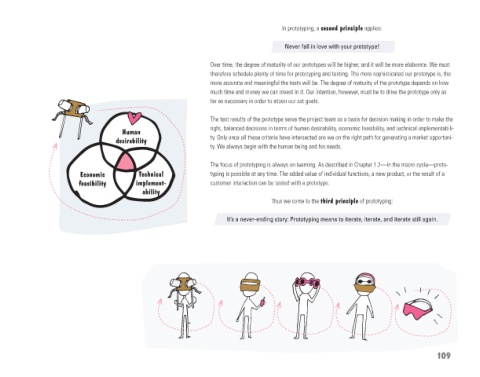
                                                             The test results of the prototype serve the project team as a basis for decision making in order to make the
                                    Human                    right, balanced decisions in terms of human desirability, economic feasibility, and technical implementabili-
                                  desirability               ty. Only once all these criteria have intersected are we on the right path for generating a market opportuni-
                                                             ty. We always begin with the human being and his needs.

                                                             The focus of prototyping is always on learning. As described in Chapter 1.2—in the macro cycle—proto-
                        Economic         Technical           typing is possible at any time. The added value of individual functions, a new product, or the result of a
                        feasibility     implement-           customer interaction can be tested with a prototype.
                                          ability
                                                                               Thus we come to the third principle of prototyping:

                                                                  It’s a never-ending story: Prototyping means to iterate, iterate, and iterate still again.


                                                                                                                              109

