


Page 111 - The Design Thinking Playbook
P. 111
Lilly and Jonny are still dreaming of their company, which offers
        design thinking consultancy services. After Lilly has come up with
        some initial ideas for a value proposition and possible consultancy
        priorities, she wants to test these ideas on a potential Web site that
        can also be used on mobile devices. Later in the book (see Chapter
        3.2), we will discuss in greater detail how a good value proposition is
        defined and why Lilly mainly focuses on the usability of the Web site
        for the time being.
        Back to the prototype: Lilly outlines every page of her Web site on
        paper. She can’t do anything wrong when building her prototype—un-
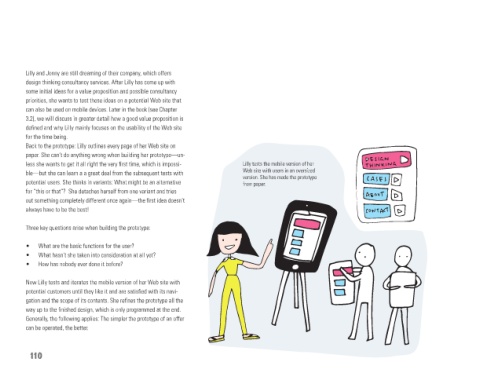
        less she wants to get it all right the very first time, which is impossi-  Lilly tests the mobile version of her
        ble—but she can learn a a great deal from the subsequent tests with   Web site with users in an oversized
                                                                      version. She has made the prototype
        potential users. She thinks in variants: What might be an alternative   from paper.
        for “this or that”?  She detaches herself from one variant and tries
        out something completely different once again—the first idea doesn’t
        always have to be the best!

        Three key questions arise when building the prototype:

        •   What are the basic functions for the user?
        •   What hasn’t she taken into consideration at all yet?
        •   How has nobody ever done it before?


        Now Lilly tests and iterates the mobile version of her Web site with
        potential customers until they like it and are satisfied with its navi-
        gation and the scope of its contents. She refines the prototype all the
        way up to the finished design, which is only programmed at the end.
        Generally, the following applies: The simpler the prototype of an offer
        can be operated, the better.


          110

