


Page 114 - The Design Thinking Playbook
P. 114
HOW MIGHT WE...

                        better discuss our ideas and portfolio consideration
                        with “boxing & shelfing”


             During the prototyping phase it is important to make the services, products, and solutions tangible so   The boxing principle can be used in other ways than as a product
             that they can be experienced. Two methods help us to realize this: The “boxing principle“ tries to use the   box as described. The added value of boxing is that the situation can
             analogy of packaging to illustrate the most important information. The “shelfing“ aims to discuss a whole   be viewed from different perspectives. Similar to the product box, a
             product portfolio and to organize the “boxes.“                          problem box, a solution box, a project box (e.g., per project or working
                                                                                     package), a process box (e.g., per process step) can be created.
             Boxing principle:
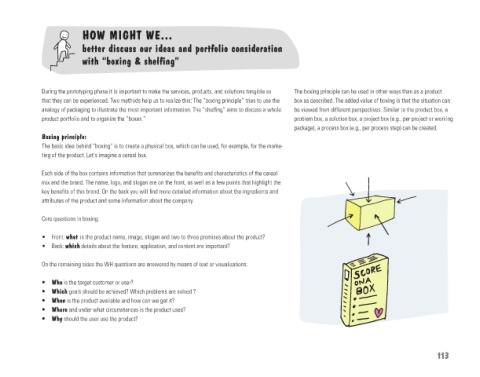
             The basic idea behind “boxing“ is to create a physical box, which can be used, for example, for the marke-
             ting of the product. Let‘s imagine a cereal box.

             Each side of the box contains information that summarizes the benefits and characteristics of the cereal
             mix and the brand. The name, logo, and slogan are on the front, as well as a few points that highlight the
             key benefits of this brand. On the back you will find more detailed information about the ingredients and
             attributes of the product and some information about the company.

             Core questions in boxing:


             •  Front: what is the product name, image, slogan and two to three promises about the product?
             •  Back: which details about the feature, application, and content are important?

             On the remaining sides the WH questions are answered by means of text or visualizations:


             •  Who is the target customer or user?
             •  Which goals should be achieved? Which problems are solved ?
             •  When is the product available and how can we get it?
             •  Where and under what circumstances is the product used?
             •  Why should the user use the product?


                                                                                                                              113

