


Page 135 - The Design Thinking Playbook
P. 135
What material do we need for the workshop and the prototyping?

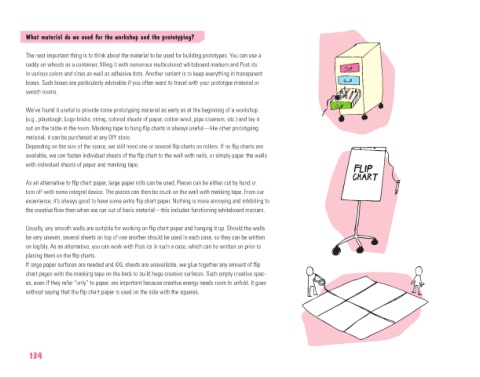
        The next important thing is to think about the material to be used for building prototypes. You can use a
        caddy on wheels as a container, filling it with numerous multicolored whiteboard markers and Post-its
        in various colors and sizes as well as adhesive dots. Another variant is to keep everything in transparent
        boxes. Such boxes are particularly advisable if you often want to travel with your prototype material or
        switch rooms.

        We’ve found it useful to provide some prototyping material as early as at the beginning of a workshop
        (e.g., playdough, Lego bricks, string, colored sheets of paper, cotton wool, pipe cleaners, etc.) and lay it
        out on the table in the room. Masking tape to hang flip charts is always useful—like other prototyping
        material, it can be purchased at any DIY store.
        Depending on the size of the space, we still need one or several flip charts on rollers. If no flip charts are
        available, we can fasten individual sheets of the flip chart to the wall with nails, or simply paper the walls
        with individual sheets of paper and masking tape.

        As an alternative to flip chart paper, large paper rolls can be used. Pieces can be either cut by hand or
        torn off with some integral device. The pieces can then be stuck on the wall with masking tape. From our
        experience, it’s always good to have some extra flip chart paper. Nothing is more annoying and inhibiting to
        the creative flow than when we run out of basic material—this includes functioning whiteboard markers.

        Usually, any smooth walls are suitable for working on flip chart paper and hanging it up. Should the walls
        be very uneven, several sheets on top of one another should be used in each case, so they can be written
        on legibly. As an alternative, you can work with Post-its in such a case, which can be written on prior to
        placing them on the flip charts.
        If large paper surfaces are needed and XXL sheets are unavailable, we glue together any amount of flip
        chart pages with the masking tape on the back to build huge creative surfaces. Such empty creative spac-
        es, even if they refer “only” to paper, are important because creative energy needs room to unfold. It goes
        without saying that the flip chart paper is used on the side with the squares.


         134

