


Page 136 - The Design Thinking Playbook
P. 136
How can I use spatial elements flexibly?

             Writable walls, window panes, or glass walls are excellent for directly writing and painting on them with
             whiteboard markers.
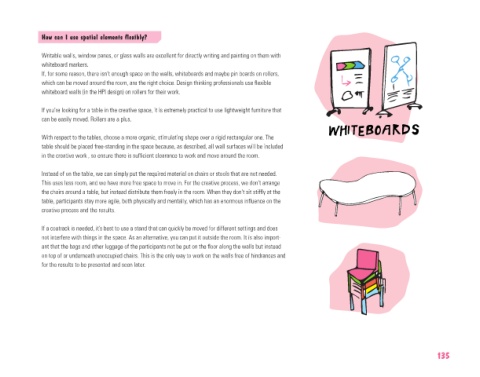
             If, for some reason, there isn’t enough space on the walls, whiteboards and maybe pin boards on rollers,
             which can be moved around the room, are the right choice. Design thinking professionals use flexible
             whiteboard walls (in the HPI design) on rollers for their work.

             If you’re looking for a table in the creative space, it is extremely practical to use lightweight furniture that
             can be easily moved. Rollers are a plus.

             With respect to the tables, choose a more organic, stimulating shape over a rigid rectangular one. The
             table should be placed free-standing in the space because, as described, all wall surfaces will be included
             in the creative work , so ensure there is sufficient clearance to work and move around the room.

             Instead of on the table, we can simply put the required material on chairs or stools that are not needed.
             This uses less room, and we have more free space to move in. For the creative process, we don’t arrange
             the chairs around a table, but instead distribute them freely in the room. When they don’t sit stiffly at the
             table, participants stay more agile, both physically and mentally, which has an enormous influence on the
             creative process and the results.

             If a coatrack is needed, it’s best to use a stand that can quickly be moved for different settings and does
             not interfere with things in the space. As an alternative, you can put it outside the room. It is also import-
             ant that the bags and other luggage of the participants not be put on the floor along the walls but instead
             on top of or underneath unoccupied chairs. This is the only way to work on the walls free of hindrances and
             for the results to be presented and seen later.


                                                                                                                              135

