


Page 182 - The Design Thinking Playbook
P. 182
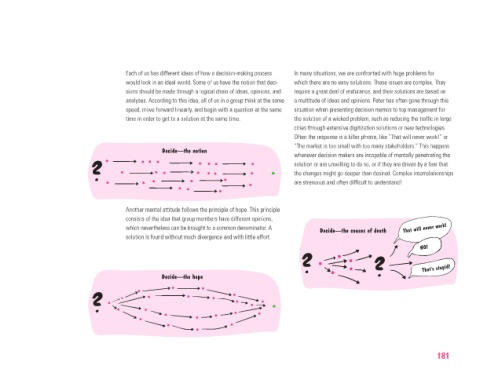
Each of us has different ideas of how a decision-making process   In many situations, we are confronted with huge problems for
                                     would look in an ideal world. Some of us have the notion that deci-  which there are no easy solutions. These issues are complex. They
                                     sions should be made through a logical chain of ideas, opinions, and   require a great deal of endurance, and their solutions are based on
                                     analyses. According to this idea, all of us in a group think at the same   a multitude of ideas and opinions. Peter has often gone through this
                                     speed, move forward linearly, and begin with a question at the same   situation when presenting decision memos to top management for
                                     time in order to get to a solution at the same time.  the solution of a wicked problem, such as reducing the traffic in large
                                                                                     cities through extensive digitization solutions or new technologies.
                                                                                     Often the response is a killer phrase, like “That will never work!” or
                                                                                     “The market is too small with too many stakeholders.” This happens
                                               Decide—the notion
                                                                                     whenever decision makers are incapable of mentally penetrating the
                                                                                     solution or are unwilling to do so, or if they are driven by a fear that
                                                                                     the changes might go deeper than desired. Complex interrelationships
                                                                                     are strenuous and often difficult to understand!


                                     Another mental attitude follows the principle of hope. This principle
                                     consists of the idea that group members have different opinions,
                                     which nevertheless can be brought to a common denominator. A   Decide—the causes of death  That will never work!
                                     solution is found without much divergence and with little effort.
                                                                                                                         NO!

                                                                                                                          That’s stupid!
                                               Decide—the hope


                                                                                                                              181

