


Page 185 - The Design Thinking Playbook
P. 185
EXPERT TIP
                    Adequate system for dialog


        How do we put together the team to promote dialog?


        The process always takes center stage for the facilitator. In terms   In addition, facilitation is based on some very specific assumptions about the company and about the
        of content, the facilitator stays neutral. Facilitation always assumes   nature of changes:
        that expertise, knowledge, and in-depth insights are available in the
        company itself. A facilitator creates the space for us to be able to   •   Trust the process.
        exchange ideas in an adequate system. This exchange has the goal of   •   The knowledge of change rests in the system.
        enabling consistent, precise, effective, and successful collaboration.  •   Have a low profile as a facilitator and don’t push yourself to the front.
                                                         •   Build up a community before decisions are made.
        According to the ARE IN formula, an adequate system consists of   •   Control what you can control, otherwise let it be.
        participants representing the following:         •   If a method or intervention does not help the group, forget it.
                                                         •   What we focus our attention on will become reality.
        A uthority—who has the power to initiate change?  •   People want to take responsibility and do something meaningful.
        R esources—who contributes specific necessary resources?  •   Everybody is doing his or her best.
        E xpertise—who has experience and a very extensive range of
        knowledge?                                       Based on these assumptions, facilitators develop specific approaches to initiate participation processes
        I nformation—who provides us with information, including the   and to support teams.
        informal kind?
        N eed—who knows the needs of our customers and users?
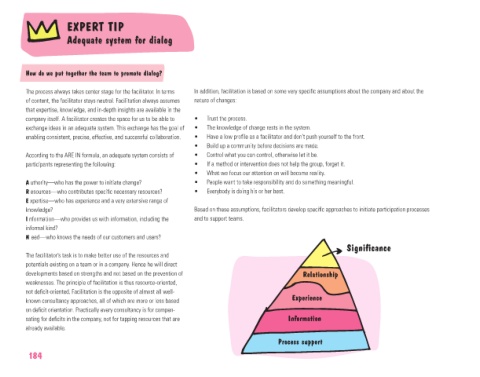
                                                                                                    Significance
        The facilitator’s task is to make better use of the resources and
        potentials existing on a team or in a company. Hence he will direct
        developments based on strengths and not based on the prevention of              Relationship
        weaknesses. The principle of facilitation is thus resource-oriented,
        not deficit-oriented. Facilitation is the opposite of almost all well-
        known consultancy approaches, all of which are more or less based           Experience
        on deficit orientation. Practically every consultancy is for compen-
        sating for deficits in the company, not for tapping resources that are     Information
        already available.
                                                                                Process support
         184

