


Page 181 - The Design Thinking Playbook
P. 181
2.5  How to trigger change as a facilitator


        We all assume the role of facilitator sometimes. For example, in this   Is there is a typical facilitator attitude that is vital and important for change and
        function, Jonny has invited Lilly to a design thinking workshop for   transformation?
        developing a creative space. Marc has found a suitable team for the
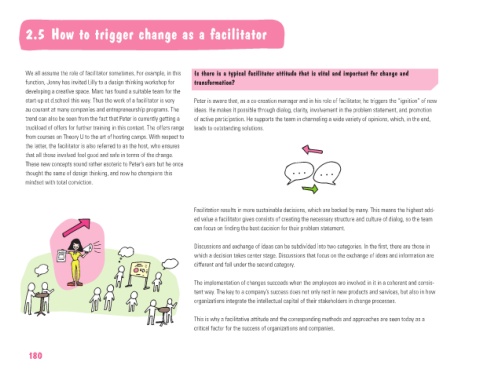
        start-up at d.school this way. Thus the work of a facilitator is very   Peter is aware that, as a co-creation manager and in his role of facilitator, he triggers the “ignition” of new
        au courant at many companies and entrepreneurship programs. The   ideas. He makes it possible through dialog, clarity, involvement in the problem statement, and promotion
        trend can also be seen from the fact that Peter is currently getting a   of active participation. He supports the team in channeling a wide variety of opinions, which, in the end,
        truckload of offers for further training in this context. The offers range   leads to outstanding solutions.
        from courses on Theory U to the art of hosting camps. With respect to
        the latter, the facilitator is also referred to as the host, who ensures
        that all those involved feel good and safe in terms of the change.
        These new concepts sound rather esoteric to Peter’s ears but he once
        thought the same of design thinking, and now he champions this
        mindset with total conviction.


                                                        Facilitation results in more sustainable decisions, which are backed by many. This means the highest add-
                                                        ed value a facilitator gives consists of creating the necessary structure and culture of dialog, so the team
                                                        can focus on finding the best decision for their problem statement.

                                                        Discussions and exchange of ideas can be subdivided into two categories. In the first, there are those in
                                                        which a decision takes center stage. Discussions that focus on the exchange of ideas and information are
                                                        different and fall under the second category.


                                                        The implementation of changes succeeds when the employees are involved in it in a coherent and consis-
                                                        tent way. The key to a company’s success does not only rest in new products and services, but also in how
                                                        organizations integrate the intellectual capital of their stakeholders in change processes.

                                                        This is why a facilitative attitude and the corresponding methods and approaches are seen today as a
                                                        critical factor for the success of organizations and companies.


         180

