


Page 257 - The Design Thinking Playbook
P. 257
How do the developed solutions get to the market?
                                                                                   IMPLEMENTATION =
        For Lilly, her work at the university was usually over once the participants had presented their results. The
        implementation of the solution was not a major issue for her. Yet the feedback from industry partners and   We asked 200 people...
        participants on the implementation made her think. Most celebrated opportunities do not find their way to
        market maturity.
        In the case of rather simple market opportunities, the approach discussed before, namely to implement
        the idea with a start-up, is probably the simplest. You equip the teams with financial resources for one
        year, support them with coaching, and try to develop the opportunity to market maturity during this time.   What are the effects
        For one, this minimizes the risk; you also avoid all those hurdles that are simply written in the DNA of
        traditional enterprises. Such implementation variants have unfortunately been chosen only rarely up to   of design thinking?
        now. This is because, among other things, it requires the willingness of the team to carry forward the idea
        in a venture for a while.
                                                                                          Innovation processes are
                                                                                             more efficient
                                                                                                            We have a better
                                                                                                              work culture
        Execution is the key!

        But Lilly also knows very well that implementation will be one of the most important factors of success   Costs
        in the future. From a study jointly conducted by HPI and Stanford in 2015, Lilly knows that design thinking   were reduced  Users were
        brings forth many positive aspects in the field of work culture and collaboration. What is conspicuous,   more integrated
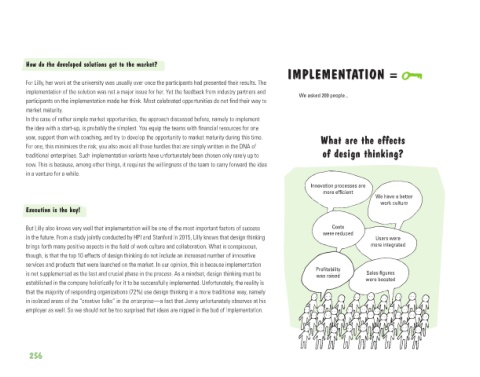
        though, is that the top 10 effects of design thinking do not include an increased number of innovative
        services and products that were launched on the market. In our opinion, this is because implementation
                                                                                           Profitability
        is not supplemented as the last and crucial phase in the process. As a mindset, design thinking must be   was raised  Sales figures
        established in the company holistically for it to be successfully implemented. Unfortunately, the reality is   were boosted
        that the majority of responding organizations (72%) use design thinking in a more traditional way, namely
        in isolated areas of the “creative folks” in the enterprise—a fact that Jonny unfortunately observes at his
        employer as well. So we should not be too surprised that ideas are nipped in the bud of implementation.


         256

