


Page 260 - The Design Thinking Playbook
P. 260
EXPERT TIP
                         Flat and agile organizations


                                                                                                                       Agile
             Every large enterprise dreams of the flat and agile organizational structures of a create-up that allow
             for the quick piloting and implementing of market opportunities. Transforming an entire organization is a
             longer task, so a step-by-step approach is advisable.

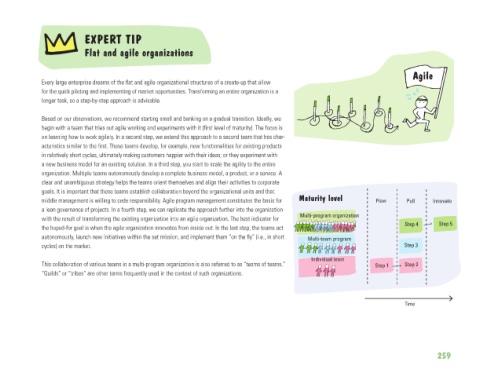
             Based on our observations, we recommend starting small and banking on a gradual transition. Ideally, we
             begin with a team that tries out agile working and experiments with it (first level of maturity). The focus is
             on learning how to work agilely. In a second step, we extend this approach to a second team that has char-
             acteristics similar to the first. These teams develop, for example, new functionalities for existing products
             in relatively short cycles, ultimately making customers happier with their ideas; or they experiment with
             a new business model for an existing solution. In a third step, you start to scale the agility to the entire
             organization. Multiple teams autonomously develop a complete business model, a product, or a service. A
             clear and unambiguous strategy helps the teams orient themselves and align their activities to corporate
             goals. It is important that these teams establish collaboration beyond the organizational units and that
             middle management is willing to cede responsibility. Agile program management constitutes the basis for   Maturity level  Flow  Pull  Innovate
             a lean governance of projects. In a fourth step, we can replicate the approach further into the organization
             with the result of transforming the existing organization into an agile organization. The best indicator for   Multi-program organization
             the hoped-for goal is when the agile organization innovates from inside out. In the last step, the teams act   Step 4  Step 5
             autonomously, launch new initiatives within the set mission, and implement them “on the fly” (i.e., in short   Multi-team program
             cycles) on the market.                                                                                  Step 3

                                                                                          Individual team
             This collaboration of various teams in a multi-program organization is also referred to as “teams of teams.”   Step 1  Step 2
             “Guilds” or “tribes” are other terms frequently used in the context of such organizations.


                                                                                                                     Time


                                                                                                                              259

