


Page 256 - The Design Thinking Playbook
P. 256
Design thinking as such offers a great basis for initiating transforma-  As described in earlier chapters, collaboration with partners is becoming more and more vital for success
             tion and innovating in an agile way. We consciously bank on interdis-  in the digitized world. Many components can be provided by companies in the business ecosystem, in
             ciplinary teams and radical collaboration, promote an experimental   particular when it comes to technologies that we don’t master ourselves. Collaboration can be stimulat-
             process through iterations, and thus maximize the learning success.  ing for the development of the actual idea. The advantages are obvious: We boost speed and efficiency,
             Nonetheless, many of our ideas fall by the wayside and never get   participate in new trends and technologies, and reduce development costs. As a company, however, we
             to market. As mentioned, one of the core problems here is that the   need the ability to deal with open innovation models for this, especially in the form of collaboration, and
             stakeholders in the company are not part of the creative nucleus   explorative/exploitative skills. With regard to the latter, we are swiftly confronted with the problem of
             and often act within the structures and mindset of yesteryear. The   intellectual property (IP). But what seems to be even more important today are aspects such as who owns
             style in which leadership is lived is frequently resistant to change in   the data of digital solutions and the question of usability.
             implementation projects. Even at a late stage—just before the market
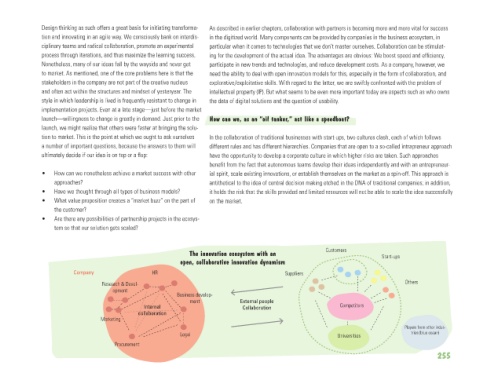
             launch—willingness to change is greatly in demand. Just prior to the   How can we, as an “oil tanker,” act like a speedboat?
             launch, we might realize that others were faster at bringing the solu-
             tion to market. This is the point at which we ought to ask ourselves   In the collaboration of traditional businesses with start-ups, two cultures clash, each of which follows
             a number of important questions, because the answers to them will   different rules and has different hierarchies. Companies that are open to a so-called intrapreneur approach
             ultimately decide if our idea is on top or a flop:  have the opportunity to develop a corporate culture in which higher risks are taken. Such approaches
                                                             benefit from the fact that autonomous teams develop their ideas independently and with an entrepreneur-
             •   How can we nonetheless achieve a market success with other   ial spirit, scale existing innovations, or establish themselves on the market as a spin-off. This approach is
                 approaches?                                 antithetical to the idea of central decision making etched in the DNA of traditional companies; in addition,
             •   Have we thought through all types of business models?   it holds the risk that the skills provided and limited resources will not be able to scale the idea successfully
             •   What value proposition creates a “market buzz” on the part of   on the market.
                 the customer?
             •   Are there any possibilities of partnership projects in the ecosys-
                 tem so that our solution gets scaled?


                                                                                              Customers
                                                       The innovation ecosystem with an                       Start-ups
                                                     open, collaborative innovation dynamism
                      Company               HR                                    Suppliers
                              Research & Devel-                                                                      Others
                                 opment
                                                    Business develop-
                                                       ment           External people
                                          Internal                    Collaboration               Competitors
                                        collaboration
                              Marketing
                                                                                                                     Players from other indus-
                                                    Legal                                        Universities          tries (blue ocean)
                                  Procurement
                                                                                                                              255

