


Page 150 - Learn To Program With Scratch
P. 150
Knowing this, it shouldn’t surprise you when the expression elephant >
                         mouse evaluates to false, even though actual elephants are much larger than
                         mice. According to Scratch’s string comparison rules, the string “ elephant”
                         is less than the string “mouse” because the letter e (the first  letter in elephant)
                         comes before the letter m (the first letter in mouse) in the alphabet.
                             Comparing and sorting strings based on the alphabetical order of their
                         characters is used in many real-life situations, including ordering directory
                         listings, books on bookshelves, words in dictionaries, and so on. The word
                         elephant comes before the word mouse in the dictionary, and string compari-
                         son in Scratch gives an answer based on this order.
                             Now that you understand what relational operators are and how Scratch
                         uses these operators to compare numbers and strings, it’s time to learn about
                         conditional blocks.


              decision Structures
                         Scratch’s Control palette contains two blocks that allow you to make deci-
                         sions and control actions in your programs: the if block and the if/else
                         block. Using these blocks, you can ask a question and take a course of
                         action based on the answer. In this section, we’ll discuss these two blocks
                         in detail, talk about flags, and learn to test multiple conditions with nested
                         if blocks. I’ll then introduce menu-driven applications and explain how
                         nested if blocks can aid in their implementation.

                         The if Block

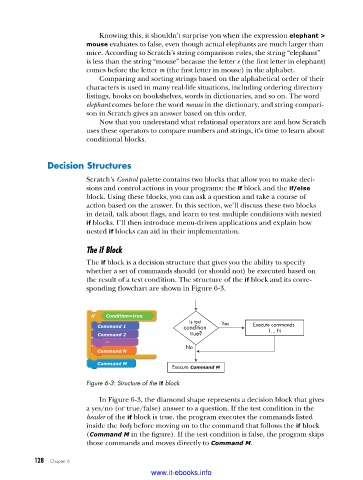
                         The if block is a decision structure that gives you the ability to specify
                         whether a set of commands should (or should not) be executed based on
                         the result of a test condition. The structure of the if block and its corre-
                         sponding flowchart are shown in Figure 6-3.


                          if  Condition=true
                                                      Is test   Yes
                            Command 1               condition          Execute commands
                                                                           1... N
                            Command 2                 true?
                              ...
                                                     No
                            Command N
                            Command M
                                                 Execute Command M

                         Figure 6-3: Structure of the if block

                             In Figure 6-3, the diamond shape represents a decision block that gives
                         a yes/no (or true/false) answer to a question. If the test condition in the
                         header of the if block is true, the program executes the commands listed
                         inside the body before moving on to the command that follows the if block
                         (Command M in the figure). If the test condition is false, the program skips
                         those commands and moves directly to Command M.


           128   Chapter 6
                                           www.it-ebooks.info

