


Page 153 - Learn To Program With Scratch
P. 153
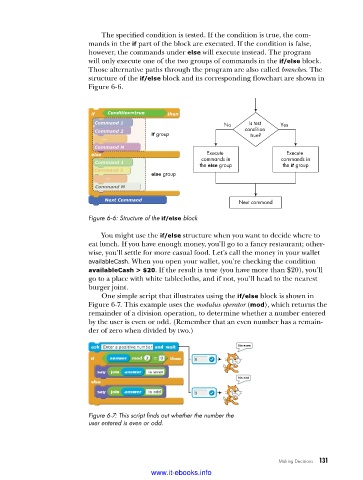
The specified condition is tested. If the condition is true, the com-
                          mands in the if part of the block are executed. If the condition is false,
                          however, the commands under else will execute instead. The program
                          will only execute one of the two groups of commands in the if/else block.
                          Those alternative paths through the program are also called branches. The
                          structure of the if/else block and its corresponding flowchart are shown in
                          Figure 6-6.


                          if   Condition=true   then
                           Command 1                           No     Is test   Yes
                           Command 2       if group                  condition
                             ...                                       true?
                           Command N
                          else                            Execute                Execute
                                                         commands in
                           Command 1                    the else group         commands in

                                                                                the if group
                           Command 2       else group
                              ...
                           Command M
                              Next Command                         Next command

                          Figure 6-6: Structure of the if/else block

                             You might use the if/else structure when you want to decide where to
                          eat lunch. If you have enough money, you’ll go to a fancy restaurant; other-
                          wise, you’ll settle for more casual food. Let’s call the money in your wallet
                          availableCash. When you open your wallet, you’re checking the condition
                          availableCash > $20. If the result is true (you have more than $20), you’ll
                          go to a place with white tablecloths, and if not, you’ll head to the nearest
                          burger joint.
                             One simple script that illustrates using the if/else block is shown in
                          Figure 6-7. This example uses the modulus operator (mod), which returns the
                          remainder of a division operation, to determine whether a number entered
                          by the user is even or odd. (Remember that an even number has a remain-
                          der of zero when divided by two.)


                          Figure 6-7: This script finds out whether the number the
                          user entered is even or odd .


                                                                              Making Decisions   131

                                           www.it-ebooks.info

