


Page 75 - TI Journal 18-1
P. 75
IMAGING THE PERIVASCULAR SPACE                            69


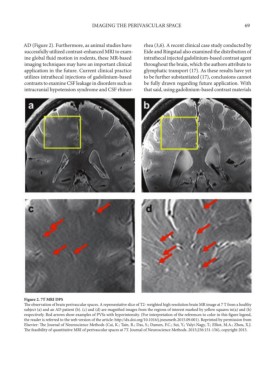
          AD (Figure 2). Furthermore, as animal studies have   rhea (3,6). A recent clinical case study conducted by
          successfully utilized contrast-enhanced MRI to exam-  Eide and Ringstad also examined the distribution of
          ine global fluid motion in rodents, these MR-based   intrathecal injected gadolinium-based contrast agent
          imaging techniques may have an important clinical   throughout the brain, which the authors attribute to
          application in the future. Current clinical practice   glymphatic transport (17). As these results have yet
          utilizes intrathecal injections of gadolinium-based   to be further substantiated (17), conclusions cannot
          contrasts to examine CSF leakage in disorders such as   be fully drawn regarding future application. With
          intracranial hypotension syndrome and CSF rhinor-  that said, using gadolinium-based contrast materials


          Figure 2. 7T MRI DPS
          The observation of brain perivascular spaces. A representative slice of T2- weighted high resolution brain MR image at 7 T from a healthy
          subject (a) and an AD patient (b). (c) and (d) are magnified images from the regions of interest marked by yellow squares in(a) and (b)
          respectively. Red arrows show examples of PVSs with hyperintensity. (For interpretation of the references to color in this figure legend,
          the reader is referred to the web version of the article: http://dx.doi.org/10.1016/j.jneumeth.2015.09.001). Reprinted by permission from
          Elsevier: The Journal of Neuroscience Methods (Cai, K.; Tain, R.; Das, S.; Damen, F.C.; Sui, Y.; Valyi-Nagy, T.; Elliot, M.A.; Zhou, X.J.
          The feasibility of quantitative MRI of perivascular spaces at 7T. Journal of Neuroscience Methods. 2015;256:151-156), copyright 2015.

