


Page 139 - MARSIUM'21 COMP OF PAPER
P. 139
CHAI JING MIN (2022)


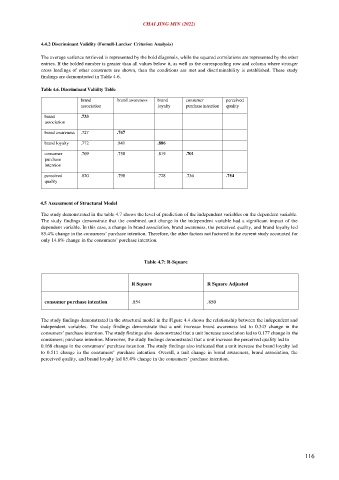
               4.4.2 Discriminant Validity (Fornell-Larcker Criterion Analysis)

               The average variance retrieved is represented by the bold diagonals, while the squared correlations are represented by the other
               entries. If the bolded number is greater than all values below it, as well as the corresponding row and column where stronger
               cross loadings of other constructs are shown, then the conditions are met and discriminability is established. These study
               findings are demonstrated in Table 4.6.

               Table 4.6. Discriminant Validity Table

                             brand        brand awareness   brand   consumer    perceived
                             association                loyalty   purchase intention   quality
                 brand       .733
                 association
                 brand awareness   .727   .747

                 brand loyalty   .772     .841          .886
                 consumer    .769         .758          .819      .701
                 purchase
                 intention
                 perceived   .820         .798          .728      .736          .754
                 quality


               4.5 Assessment of Structural Model

               The study demonstrated in the table 4.7 shows the level of prediction of the independent variables on the dependent variable.
               The study findings demonstrate that the  combined unit change in the independent variable had a significant impact of the
               dependent variable. In this case, a change in brand association, brand awareness, the perceived quality, and brand loyalty led
               85.4% change in the consumers’ purchase intention. Therefore, the other factors not factored in the current study accounted for
               only 14.6% change in the consumers’ purchase intention.


                                                    Table 4.7: R-Square


                                               R Square                   R Square Adjusted

                 consumer purchase intention   .854                       .850

               The study findings demonstrated in the structural model in the Figure 4.4 shows the relationship between the independent and
               independent  variables.  The  study  findings  demonstrate  that  a  unit  increase  brand  awareness  led  to  0.345  change  in  the
               consumers’ purchase intention. The study findings also  demonstrated that a unit increase association led to 0.177 change in the
               consumers; purchase intention. Moreover, the study findings demonstrated that a unit increase the perceived quality led to
               0.168 change in the consumers’ purchase intention. The study findings also indicated that a unit increase the brand loyalty led
               to  0.511  change  in  the  consumers’  purchase  intention.  Overall,  a  unit  change  in  brand  awareness,  brand  association,  the
               perceived quality, and brand loyalty led 85.4% change in the consumers’ purchase intention.


                                                                                                            116

