


Page 298 - MARSIUM'21 COMP OF PAPER
P. 298
277                                        Chen (2021)


               4.0 DATA ANALYSIS PLAN

               4.1 Demographic details of respondents

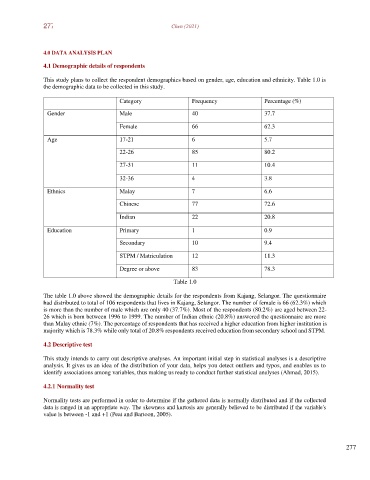
               This study plans to collect the respondent demographics based on gender, age, education and ethnicity. Table 1.0 is
               the demographic data to be collected in this study.

                                         Category                Frequency              Percentage (%)

                 Gender                  Male                    40                     37.7
                                         Female                  66                     62.3

                 Age                     17-21                   6                      5.7

                                         22-26                   85                     80.2
                                         27-31                   11                     10.4

                                         32-36                   4                      3.8

                 Ethnics                 Malay                   7                      6.6
                                         Chinese                 77                     72.6

                                         Indian                  22                     20.8

                 Education               Primary                 1                      0.9
                                         Secondary               10                     9.4

                                         STPM / Matriculation    12                     11.3

                                         Degree or above         83                     78.3
                                                          Table 1.0

               The table 1.0 above showed the demographic details for the respondents from Kajang, Selangor. The questionnaire
               had distributed to total of 106 respondents that lives in Kajang, Selangor. The number of female is 66 (62.3%) which
               is more than the number of male which are only 40 (37.7%). Most of the respondents (80.2%) are aged between 22-
               26 which is born between 1996 to 1999. The number of Indian ethnic (20.8%) answered the questionnaire are more
               than Malay ethnic (7%). The percentage of respondents that has received a higher education from higher institution is
               majority which is 78.3% while only total of 20.8% respondents received education from secondary school and STPM.

               4.2 Descriptive test

               This study intends to carry out descriptive analyses. An important initial step in statistical analyses is a descriptive
               analysis. It gives us an idea of the distribution of your data, helps you detect outliers and typos, and enables us to
               identify associations among variables, thus making us ready to conduct further statistical analyses (Ahmad, 2015).

               4.2.1 Normality test

               Normality tests are performed in order to determine if the gathered data is normally distributed and if the collected
               data is ranged in an appropriate way. The skewness and kurtosis are generally believed to be distributed if the variable's
               value is between -1 and +1 (Peat and Bartoon, 2005).


                                                                                                                    277

