


Page 314 - MARSIUM'21 COMP OF PAPER
P. 314
Intan Yusniza (2022)


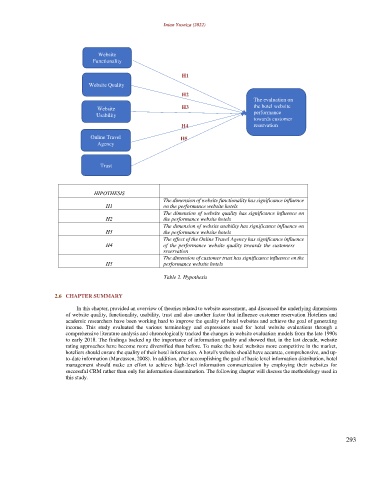
                                  Website
                                Functionality


                                                             H1
                              Website Quality
                                                             H2
                                                                                     The evaluation on
                                 Website                     H3                      the hotel website
                                 Usability                                           performance
                                                                                     towards customer
                                                             H4                      reservation
                               Online Travel
                                 Agency                      H5


                                  Trust


                                HIPOTHESIS
                                                       The dimension of website functionality has significance influence
                                    H1                 on the performance website hotels
                                                       The dimension of website quality has significance influence on
                                    H2                 the performance website hotels
                                                       The dimension of website usability has significance influence on
                                    H3                 the performance website hotels
                                                       The effect of the Online Travel Agency has significance influence
                                    H4                 of the performance website quality  towards  the  customers
                                                       reservation
                                                       The dimension of customer trust has significance influence on the
                                    H5                 performance website hotels

                                                       Table 2. Hypothesis

                   2.6  CHAPTER SUMMARY

                          In this chapter, provided an overview of theories related to website assessment, and discussed the underlying dimensions
                       of website quality, functionality, usability, trust and also another factor that influence customer reservation Hoteliers and
                       academic researchers have been working hard to improve the quality of hotel websites and achieve the goal of generating
                       income.  This  study  evaluated  the  various  terminology  and  expressions  used  for  hotel  website  evaluations  through  a
                       comprehensive literature analysis and chronologically tracked the changes in website evaluation models from the late 1990s
                       to early 2018. The findings backed up the importance of information quality and showed that, in the last decade, website
                       rating approaches have become more diversified than before. To make the hotel websites more competitive in the market,
                       hoteliers should ensure the quality of their hotel information. A hotel's website should have accurate, comprehensive, and up-
                       to-date information (Marcussen, 2008). In addition, after accomplishing the goal of basic level information distribution, hotel
                       management  should  make  an  effort  to  achieve  high-level  information  communication  by  employing  their  websites  for
                       successful CRM rather than only for information dissemination. The following chapter will discuss the methodology used in
                       this study.


                                                                                                                    293

